


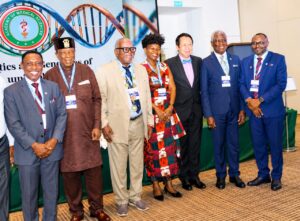
L-R: Professor Mayowa Owolabi, FAMedS (Academy Secretary, Academy of Medical Sciences), Professor Oladapo, Ashiru FAMedS (Foundation President, Academy of Medical Sciences), Emeritus Professor Frank Osato Giwa-Osagie, FAMedS (Outgoing President, Academy of Medical Sciences), Professor Sunday Chinenye, FAMedS (Guest Speaker, Augustine Ohwovoriole Annual Memorial Lecture), Olor’ogun Dr Sonny Kuku, FAMedS (BoT Chairman, Academy of Medical Sciences), Professor Joseph Ahaneku, FAMedS (Incoming President, Academy of Medical Sciences) at the Academy’s Annual Scientific Conference/Annual Augustine Ohwovoriole Annual Memorial Lecture held in Lagos on Friday, 30th of October.
Chinyere Ikeanyi
The Academy of Medical Sciences of Nigeria has urged the Federal Government to increase funding for genomic and biomedical research, warning that the country risks being unprepared for future pandemics while losing opportunities to develop affordable treatments, create jobs and strengthen its healthcare system.
The Academy said Nigeria must move beyond emergency responses to disease outbreaks by investing in scientific research, vaccine development and genomic medicine to build the capacity to prevent, detect and manage emerging health threats.
Speaking at the Academy’s 2026 Annual Scientific Conference and Augustine Ohwovoriole Annual Memorial Lecture at the Marriott Hotel, Ikeja GRA, Lagos, on Friday, keynote speaker Professor Azeez Butali said sustained investment in biomedical research would deliver substantial economic returns while improving the country’s ability to tackle diseases.
Butali, Gilbert Lilly Endowed Professor of Diagnostic Sciences at the University of Iowa, United States, cited the economic impact of the Human Genome Project, noting that every dollar invested in the initiative generated about $141 in returns to the government.
He argued that Nigeria could reap similar benefits by funding local research, developing affordable treatments and creating an environment that encourages young scientists to build their careers in the country.
“Twelve years after Ebola, we are facing another scare, and we are busy doing the same things we did the first time: shutting the ports and taking other precautionary measures. No. Invest in biomedical research, develop vaccines and prepare your people so that their immune systems can fight future exposure,” Butali said.
He warned that reliance on restrictive emergency measures without adequate investment in research would leave Nigeria vulnerable to recurring health crises.
The professor also highlighted the country’s burden of sickle cell disease, lamenting that many patients could not afford existing treatment options, including bone marrow transplantation.
According to him, increased research funding would help scientists explore more accessible treatment options, expand local expertise and improve outcomes for people living with inherited diseases.
President of the Academy, Professor Oladapo Ashiru, backed the call, describing genomic medicine as “no longer a luxury but an urgent necessity.”
Ashiru said Nigeria had trained professionals capable of advancing genomic research but continued to depend heavily on collaborations with institutions in the United States, the United Kingdom and Japan.
He called for the establishment of a national centre for genomic diseases, modelled after similar initiatives in countries such as Thailand, to coordinate research, strengthen diagnostic capacity and translate scientific discoveries into clinical care.
The Academy president also raised concern over the limited identification of genomic conditions in Nigeria, estimating that only about two per cent had been identified, leaving many citizens with undiagnosed genetic disorders and limited access to appropriate care.
He noted that advances in reproductive genetics now make it possible to screen embryos for certain inherited conditions, including sickle cell disease, before implantation, potentially reducing the incidence of some genetic disorders.
Ashiru said expanding access to such scientific advances would require stronger research institutions, sustained government support and improved public awareness.
Associate Professor of Human Genetics and Genomics at the University of Ghana, Lily Paemka, called for greater representation of African populations in global genetic studies, warning that the underrepresentation of Black people was limiting scientific understanding of diseases affecting the continent.
Paemka, who is also Deputy Director of the West African Genetic Medicine Centre, said only about two per cent of current genetic research involved Black populations, despite Africa’s exceptional genetic diversity and its potential to help scientists identify new disease-causing genes.
She argued that greater inclusion of African genomes would improve understanding of disease patterns, support the development of more effective treatments and ensure that medical advances reflected the needs of African populations.
Paemka also expressed concern over the late presentation of cancer patients and the aggressive nature of certain cancers among African populations, factors she said contributed to poor survival outcomes.
She urged stakeholders to intensify public education to challenge misconceptions surrounding cancer, particularly beliefs that portray the disease as a curse rather than a medical condition requiring timely diagnosis and treatment.
Another speaker, Professor Nik Kantaputra of Chiang Mai University, Thailand, stressed the importance of identifying the genetic causes of rare diseases, noting that accurate diagnosis was essential for effective treatment, early intervention and improved patient outcomes.
The conference, themed “The Genetics and Genomics of Non-Communicable Diseases: Integrating Science Into Clinical Care,” brought together experts to examine how advances in genetics and genomics could improve disease prevention, diagnosis and treatment.
The Academy maintained that increased domestic investment, wider public participation in research and better utilisation of Nigerian expertise were critical to reducing the burden of inherited diseases and strengthening the healthcare system.
It urged the Federal Government to prioritise genomic and biomedical research as part of a long-term national health strategy, warning that without sustained funding, Nigeria could remain dependent on external scientific advances while struggling to respond effectively to future disease outbreaks.
For a better society
_______________________________
Follow us across our platforms:
Instagram – https://www.instagram.com/championnewsonline/
Facebook – https://web.facebook.com/championnewsonline
LinkedIn – https://www.linkedin.com/company/champion-newspapers-limited/
https://x.com/championnewsng/
You can also like and comment on our YouTube videos.
https://youtu.be/QIBfD1tT80w?si=R4Qf3so2LxYu3GC2