The Bayelsa State Government has disclosed that it received a total of N183.28 billion from the Federation Account Allocation Committee (FAAC) and other revenue sources in August and September 2026, while reaffirming its commitment to completing ongoing infrastructure projects and improving workers’ welfare.
The government also disclosed that it had paid salaries to 65,411 workers and approved additional allowances for civil servants and employees of tertiary institutions, with implementation commencing in October 2026.
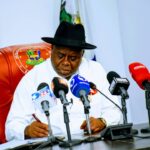
The commissioner for information, orientation and strategy, Ebiuwou Koku-Obiyai, made the disclosures during the state’s financial transparency briefing in Yenagoa, where she dismissed social media reports alleging that some major government projects had been abandoned or had collapsed.
Koku-Obiyai maintained that ongoing projects were progressing in line with their respective timelines, stressing that the government had continued to meet its financial obligations to contractors to ensure timely completion.
She listed the nine-storey state secretariat building, the rehabilitation of the nine-storey project and the Lagos road project among the major infrastructure projects making progress.
According to her, an inspection tour conducted by the commissioner for works and other government officials confirmed that the Lagos Road project had reached an advanced stage of implementation.
She described reports alleging the collapse of major projects as misleading, insisting that the government remained committed to delivering its development agenda.
Presenting the state’s revenue and expenditure profile for the two months, Timipre Seipulo said Bayelsa recorded a gross FAAC inflow of N79.20 billion in August, comprising N12.71 billion from statutory allocation, N50.14 billion from derivation revenue and N16.36 billion from Value Added Tax (VAT).
He explained that after deductions at source, the state’s net FAAC receipt stood at N78.21 billion,additional receipts from internally generated revenue, infrastructure development funds, excess crude refunds and other sources brought the state’s total revenue for August to approximately N99.21 billion.
For september, Seipolu said the state received a gross FAAC allocation of N56.60 billion, comprising N8.6 billion from statutory allocation, N39.32 billion from derivation revenue and N8.7 billion from VAT.”
He said that after deductions, the net FAAC inflow stood at approximately N55.05 billion, while additional revenue from internally generated revenue, infrastructure development funds, natural resources development, the state employment and expenditure for Results (SEEFOR) programme and other sources increased the state’s total receipts to about N84.07 billion.
The financial presentation showed that the government spent N7.26 billion on recurrent expenditure and N28.36 billion on capital projects in september, bringing the total expenditure for the month to N35.62 billion.
Seipolu further disclosed that the state had a closing balance of approximately N59.04 billion at the end of September.
However, he explained that between the end of september and october 19, before the receipt of the next FAAC allocation, the government spent about N18.9 billion on capital projects and N4.9 billion on recurrent obligations.
He said the state’s balance consequently stood at approximately N35.5 billion as of October 19, with N24 billion retained in the capital projects account to support ongoing infrastructure development.
According to him, the funds were not idle resources but were being deployed to meet government obligations and finance ongoing projects pending subsequent FAAC allocations.
On workers’ welfare the government clarified that different categories of public servants operate under distinct salary structures and allowance arrangements.
It explained that doctors, nurses, investigators, civil servants, university employees and fire service personnel have different remuneration structures, making it inappropriate to calculate the state’s wage bill based on a uniform salary estimate.
The government added that professionals, including doctors, nurses and investigators, receive special allowances in addition to their regular salaries in recognition of the peculiar demands and responsibilities of their duties.
It also announced that approved special allowances for workers in tertiary institutions would commence in October, with the government committing to pay outstanding arrears dating back to January 2026.
The allowances for tertiary institution workers are expected to increase the monthly wage bill by more than N900 million, while additional peculiar allowances for other public servants are projected to raise monthly salary expenditure by approximately N2 billion.
The government said the two adjustments would increase the state’s monthly wage bill by about N3 billion, excluding outstanding arrears.
It maintained that the financial disclosure was part of its commitment to transparency, accountability and responsible management of public resources.