

.INEC sets Osun election as benchmark for 2027
Kasie Abone, Onitsha with Agency report
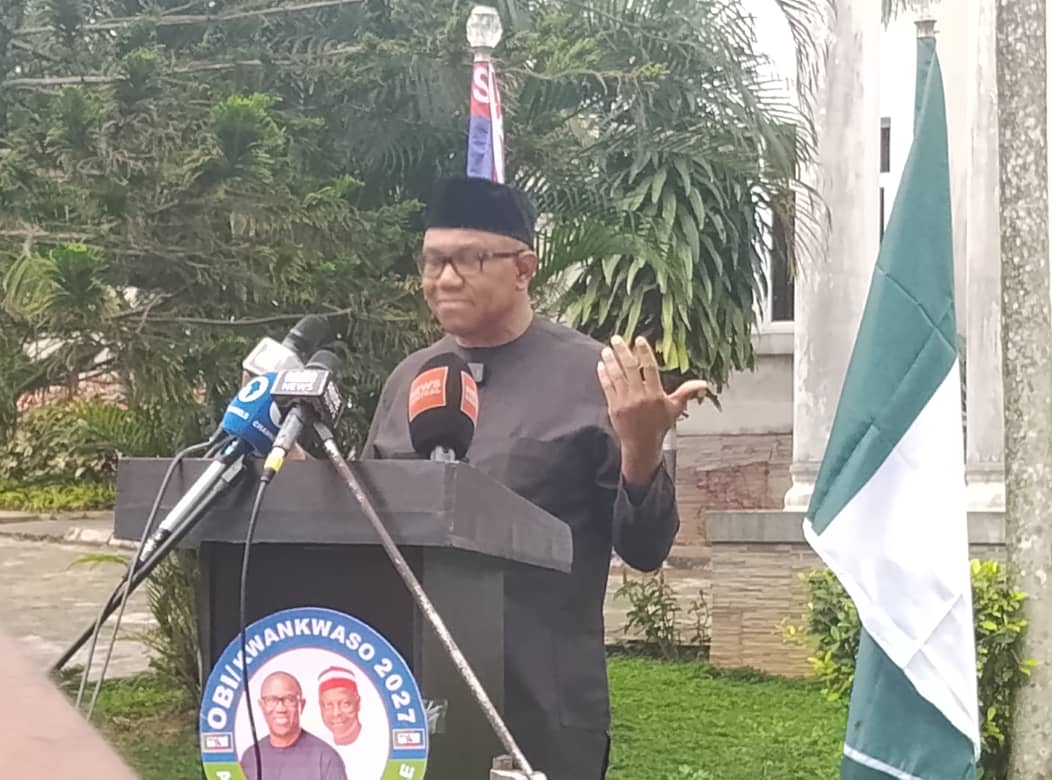
Presidential candidate of the Nigeria Democratic Congress (NDC), Peter Obi, has declared that Nigeria can overcome its economic and security challenges if the country embraces disciplined leadership, production-driven policies and investments in human capital.
Obi, who spoke on Friday at a press conference to formally mark the commencement of the 2027 presidential and National Assembly campaigns, said he was entering the race with the conviction that “Nigeria can work, and Nigeria must work.”
He said the 2027 election presented Nigerians with a defining opportunity to scrutinise the records, competence, character and policy proposals of those seeking to govern the country.
The former Anambra State governor, who is seeking the presidency alongside Senator Rabiu Musa Kwankwaso, said the country was confronted by widespread poverty, food insecurity, unemployment, insecurity, weak infrastructure and the high cost of doing business.
According to him, the challenges were not merely statistics but realities confronting Nigerian families, farmers, workers, students and businesses daily.
Obi said: “I enter this contest with one firm conviction: Nigeria can work, and Nigeria must work.”
He argued that the country possessed the population, resources, market, talent and entrepreneurial spirit required to overcome its difficulties, stressing that the priority should be to transform those advantages into “security, productivity and shared prosperity.”
‘Leadership must deliver results’
Obi said his experience in the private sector, academic exposure and tenure as governor of Anambra State had strengthened his conviction that government must manage resources responsibly, establish clear priorities and measure the outcomes of public policies.
“Public office is not a reward; it is a responsibility to the people,” he said.
He said his administration in Anambra prioritised education, healthcare, infrastructure, fiscal discipline and institutional capacity, while acknowledging that the record was not perfect.
Obi also described Kwankwaso’s experience as governor of Kano State as complementary to his own, particularly in education, technical training, scholarships, infrastructure and human-capital development.
According to him, both men’s experiences had reinforced the same conclusion that Nigeria must invest in its people and manage public resources with discipline.
Obi promises production-led economy
The NDC candidate said a future government under his leadership would focus on production, investment, enterprise and human capital rather than reactive economic reforms.
He said the real test of government should be whether Nigerians could afford food, education and healthcare, whether businesses could produce and expand, whether young people could secure productive employment, and whether farmers could work safely and access markets.
He promised to improve agricultural productivity through enhanced security for farming communities, irrigation, rural roads, storage facilities, access to finance and stronger market linkages.
He also pledged to strengthen manufacturing and agro-processing to enable Nigeria to export more finished products and retain greater value from its resources.
Obi said his administration would seek to create a business environment where entrepreneurs could invest, employ workers and expand without unnecessary regulatory and infrastructural constraints.
“Every naira should have a clear purpose, and major public investments should have measurable outcomes,” he said.
‘Nigeria cannot import its way to prosperity’
The former governor said Nigeria must urgently move from a consumption-based economy to one driven by production.
“Nigeria cannot import its way to prosperity. We will produce more of what we consume, process more of what we produce, and compete more effectively in global markets,” he declared.
He identified agriculture, manufacturing, technology, construction, energy, creative industries and services as sectors capable of transforming the nation’s economic fortunes.
According to him, Nigeria’s large population and domestic market should be treated as an economic advantage rather than a burden.
Security remains foundation of prosperity
On insecurity, Obi said no country could prosper when citizens could not safely live, farm, travel or conduct businesses.
He proposed improved intelligence gathering and coordination among security agencies, stronger policing and border management, greater use of technology and support for lawful community-based security structures capable of identifying threats early.
He also advocated the decentralisation of security management, backed by effective coordination among the different levels of government.
Obi linked insecurity directly to Nigeria’s economic and social challenges, noting that farmers could not produce food if they could not safely access their farms, while children could not learn where schools were unsafe and businesses could not thrive where goods could not move securely.
Youth population ‘greatest asset’
The presidential candidate rejected the description of Nigeria’s youthful population as a burden, describing it instead as the country’s “greatest asset” if properly equipped.
He promised to improve basic education, strengthen universities and expand technical and vocational training.
“Nigeria needs doctors, engineers, scientists and lawyers, as well as technicians, mechanics, builders, nurses, farmers, programmers, manufacturers, artisans and entrepreneurs,” he said.
Obi said the objective would be to secure a strong demographic dividend from Nigeria’s youthful population.
Promises healthcare reform
He also identified healthcare as critical to economic development, expressing concern over Nigeria’s poor health indicators, particularly maternal and infant mortality.
He promised stronger primary healthcare, improved maternal and child health services, better access to essential medicines and improved working conditions and capacity for healthcare professionals.
‘Every region must produce’
Obi said his administration would pursue a balanced national development strategy in which every region would exploit its comparative advantages while remaining connected to a productive national economy.
He identified agriculture, livestock, irrigation and agro-processing as key opportunities in the North-West; reconstruction, agriculture, education and regional trade for the North-East; and food production, processing and responsible mineral development in the North-Central.
For the South-West, he highlighted manufacturing, technology, finance, trade and the creative economy, while identifying infrastructure, connectivity and investment as priorities for unlocking the industrial and entrepreneurial strength of the South-East.
He said the South-South could derive greater value from oil and gas while expanding maritime services, fisheries and agriculture, with stronger environmental protection.
For the Federal Capital Territory, he said the focus should be on efficient urban planning, transportation, housing, sanitation, security and public services.
“Every region must produce. Every region must contribute. Every region must benefit,” Obi said.
Challenges candidates to face Nigerians
The former Anambra governor challenged all presidential candidates to subject their records, credentials and policy proposals to public scrutiny.
He urged Nigerians to ask difficult questions, demand evidence behind campaign promises and assess candidates on capacity, competence, compassion, character and commitment.
He also called for issue-based campaigns devoid of ethnic and religious divisions.
“We should debate ideas without hatred, compete without violence, and disagree without weakening the bonds that unite us,” he said.
Obi further challenged presidential candidates to physically travel across the country and engage directly with citizens rather than relying on proxies and surrogates.
“No candidate should hide behind the high walls of power, send proxies or surrogates to the hustings, and expect Nigerians to entrust them with the leadership of the country,” he said.
According to him, true leadership requires presence and empathy, particularly in communities devastated by banditry, terrorism, criminality and flooding.
‘My running mate and I will go directly to Nigerians’
Obi promised that he and his running mate would personally take their campaign to Nigerians, listen to their concerns and defend their records and character.
“Any presidential candidate who lacks the resolve to travel across the country, meet the people, and respond to their questions lacks the capacity to govern it,” he said.
He urged Nigerians to reject campaigns based on propaganda, ethnicity, religion, elitism and cronyism.
Obi said the 2027 election should ultimately be about finding leaders capable of uniting Nigeria, defeating insecurity, reducing poverty and hunger, tackling the out-of-school crisis, improving education and healthcare and creating an economy that works for all.
He concluded by pledging to begin the process of “resetting Nigeria” by uniting the country, securing it and placing it firmly on the path of inclusive economic growth.
“A New Nigeria is possible,” Obi declared.
In the meantime, the Independent National Electoral Commission has adopted the recently concluded Osun State governorship election as a benchmark for preparations for the 2027 general election, citing improved polling-unit opening, BVAS performance, electronic result transmission and crisis management.
INEC Chairman, Prof. Joash Amupitan, disclosed this on Friday when he received the Chargé d’Affaires of Canada to Nigeria, David Sproule, who led a delegation of the Canadian High Commission on a courtesy visit to the commission’s headquarters in Abuja.
Amupitan said INEC had continued to use recent off-cycle elections as testing grounds for electoral reforms and operational improvements, including the Anambra State governorship election, the FCT Area Council elections and the Ekiti State governorship election.
He said the Osun governorship election, held on August 15, had emerged as a significant benchmark for the commission.
According to Amupitan, 3,556 of the 3,763 polling units, representing 94.5 per cent, opened for accreditation and voting by 8:30am during the election.
He also cited what he described as optimal BVAS performance, seamless result uploads on the IReV portal and proactive crisis management.
“We view the success in Osun not as a final destination, but as the gold standard that will guide our preparations for 2027,” Amupitan stated.
The INEC chairman said the commission had already commenced preparations for the 2027 general election, adding that the statutory commencement of public campaigns and rallies began on August 19.
He also disclosed that INEC participated in the signing of the First National Peace Accord on Issue-Based Campaigns by presidential candidates on August 18 under the auspices of the National Peace Committee.
Amupitan identified five key areas of strategic focus for INEC ahead of the 2027 elections: “consolidating technological gains, deepening electoral inclusivity, strengthening institutional capacity and technical support, countering misinformation and safeguarding electoral integrity, and conducting a nationwide mock accreditation exercise in November 2026.”
He said the mock accreditation exercise would subject the Bimodal Voter Accreditation System and other electoral equipment to rigorous field testing.
According to him, the exercise would enable the commission to assess its readiness and address potential operational challenges before the general election.
Amupitan further disclosed that INEC was scaling up its administrative capacity for the 2027 elections, which he said would require approximately 1.4 million ad-hoc personnel across more than 176,000 polling units nationwide.
He described the operation as one of the largest mobilisations of human resources for a national assignment in Nigeria’s history.
The commission is also preparing for the increasing role of artificial intelligence in elections, with Amupitan announcing the establishment of a dedicated AI unit.
He said the unit would explore the responsible application of AI in areas including data management, voter registration and results transmission, while strengthening safeguards against its misuse.
Amupitan said INEC would participate in the “Global Conference on Responsible AI and Elections, organised by the United Nations Development Programme and Elections Canada and scheduled to hold from September 9 to 11 in Ottawa.”
He said the conference would provide an opportunity for INEC to examine responsible applications of AI in elections and develop strategies to counter emerging threats including deepfakes and disinformation.
The INEC chairman also “appealed for the Canadian High Commission’s assistance in facilitating expedited entry visas for members of the commission’s delegation attending the conference.”
Sproule reaffirmed Canada’s commitment to supporting “Nigeria’s democratic and electoral processes ahead of the 2027 general election.”
The Canadian envoy said Canada remained committed to supporting countries seeking to strengthen democratic processes and ensure elections were free, fair and enjoyed the confidence and legitimacy of their citizens.
He expressed particular interest in INEC’s preparations for the 2027 election and pledged continued Canadian engagement in electoral participation, women’s inclusion, public awareness, technical assistance and election observation.
For a better society
_______________________________
Follow us across our platforms:
Instagram – https://www.instagram.com/championnewsonline/
Facebook – https://web.facebook.com/championnewsonline
LinkedIn – https://www.linkedin.com/company/champion-newspapers-limited/
https://x.com/championnewsng/
You can also like and comment on our YouTube videos.
https://youtu.be/QIBfD1tT80w?si=R4Qf3so2LxYu3GC2