Akaiso Akaiso, Uyo
The Africa Network for Environment and Economic Justice, ANEEJ, has called for stronger collaboration among journalists, civil society organizations, anti-corruption agencies, security institutions and development partners to win the fight against Illicit Financial Flows, (IFFs) in Nigeria.
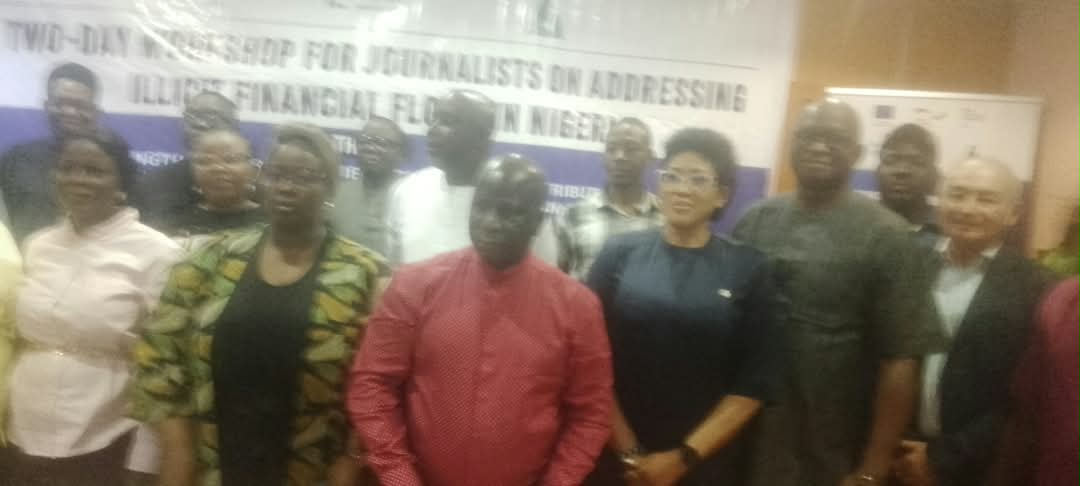
In a conference room at Villa Hilton Hotels and Suites in Uyo, Akwa Ibom State, a quiet but consequential battle took shape from Thursday to Friday, not with guns or protests, but with spreadsheets, corporate registries, and hard questions about where Nigeria’s money keeps disappearing to.
For those two days, a hand-picked group of investigative journalists sat through sessions that read more like a financial crimes master class than a typical media workshop.
Beneficial ownership structures, money laundering typologies, cross-border financial networks and trade mis-invoicing. These are not the usual staples of a newsroom training, but organisers say they have become essential tools for any reporter serious about following Nigeria’s missing billions.
The workshop with the theme, “strengthening CSOs and media capacity to contribute to the fight against illicit financial flows in Nigeria was convened by the Africa Network for Environment and Economic Justice (ANEEJ), a civil society organisation that has spent years pushing back against Illicit Financial Flows, IFFs, the shadowy movement of money out of the country through tax evasion, corruption, smuggling and outright theft.
With support from development partners, the European Union, German cooperation, Republique Francaise and SECFIN -Africa, the training was designed to sharpen the media’s ability to expose what officials and activists alike describe as one of Nigeria’s most persistent and least understood economic wounds.
Declaring the workshop open, ANEEJ’s Executive Director, David Ugolor, did not mince words about the scale of the problem or the stakes involved. “We recognize and celebrate the courage of our media colleagues who have put their lives on the line to follow the money trail,” he told participants, crediting years of dogged reporting for recoveries, prosecutions and policy reforms that might never have happened otherwise.
But Ugolor’s tone shifted from commendation to warning. The people orchestrating illicit financial flows, he said, are not standing still. “Those involved in this unwholesome trade keep increasing their tactics with sophistication,” he cautioned, pointing to an evolving toolkit that now includes shell companies, cryptocurrency, trade mis-invoicing and elaborate cross-border networks designed to obscure the true owners of stolen wealth.
Ugolor argued a reporter armed only with old-fashioned instincts and a notebook is no longer equipped to trace money that can vanish through a maze of offshore accounts in the time it takes to file a story. “This workshop is designed to build your capacity to sharpen your ability to investigate, analyze and report accurately on illicit financial flows and related crimes,” he said.
Over the two days, participants moved from theory to practice, working through case studies and hands-on exercises. They were introduced to corporate registries and financial disclosure databases as investigative tools, and trained in open-source intelligence techniques that can help trace assets stashed abroad — skills that, until recently, were the near-exclusive preserve of forensic accountants and specialised investigators.
Resource persons drawn from the Economic and Financial Crimes Commission (EFCC), the Independent Corrupt Practices and Other Related Offences Commission (ICPC), the Nigerian Financial Intelligence Unit (NFIU) and various civil society organisations walked participants through the mechanics of how the country hemorrhages billions of dollars every year. The culprits, they explained, are often mundane on paper — mis-priced trade invoices, evaded taxes, quietly diverted public funds — but devastating in their cumulative effect.
For a better society
_______________________________
Follow us across our platforms:
Instagram – https://www.instagram.com/championnewsonline/
Facebook – https://web.facebook.com/championnewsonline
LinkedIn – https://www.linkedin.com/company/champion-newspapers-limited/
https://x.com/championnewsng/
You can also like and comment on our YouTube videos.
https://youtu.be/QIBfD1tT80w?si=R4Qf3so2LxYu3GC2