
Akaiso Akaiso, Uyo
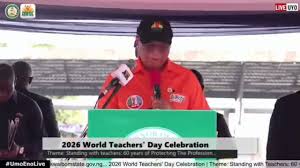
When Governor Umo Eno mounted the podium at the 2026 World Teachers’ Day celebration in Uyo yesterday, he did not come with the usual platitudes. He came with bewilderment: recruitment of additional 2,000 teachers, declaration of a state of emergency in the education sector, and a N50,000 wardrobe allowance for teachers in public schools, amongst others.
The 5,000 teachers and union leaders who gathered at the Uyo Township Stadium erupted. For a profession long derided as the last resort of the jobless, any promise of dignity sounds like revival.
But beyond the applause and dancing, critical questions must be asked: Does Akwa Ibom need 2,000 more teachers or 2,000 better teachers? Will a state of emergency be another political slogan or scam? And what can N50,000 wardrobe allowance truly do now that a good suit costs thrice that amount.
First, the recruitment. Akwa Ibom’s teacher gap is real and alarming. According to the State Secondary Education Board, many secondary schools in riverine Eastern Obolo, Mbo, Ibeno, Okobo and hinterland Ini, Obot Akara and Mkpat Enin operate with 4 to 6 teachers for over 300 students.
Subjects like Physics, Chemistry, Mathematics, ICT and French have become history in most public schools. Students sit for WAEC without ever seeing a physics teacher. Little wonder the state came second to the last In the last year NECO and WASSSE, by the way Sokoto was the last, that is understandable. In that context, 2,000 additional teachers is not generosity, it is emergency surgery.
Yet recruitment without reform is pouring water into a basket. In the last decade, Akwa Ibom has recruited over 5,000 teachers under different schemes, but absenteeism remains over 40 per cent in rural schools. Teachers posted to Ibeno lobby their way back to Uyo in two weeks.
The critical test for Eno, therefore, is not recruitment, but deployment, monitoring and retention. Will there be a binding rural allowance, housing support and digital attendance that ties salary to presence? Without this, the 2,000 will simply swell the payroll in Uyo and Eket.
Second, the state of emergency. Every administration since 1999 has declared one. Governor Victor Attah declared it, Godswill Akpabio declared it, Udom Emmanuel declared it. What changed?
An emergency, by definition, means abnormal measures: suspending bureaucracy, merging ministries for speed, deploying extra budgetary allocation, and setting measurable timelines. So far, what we have is a declaration without a white paper.
A true emergency in Akwa Ibom education must confront three cancers: infrastructure decay, learning poverty and system corruption. For example, people are still questioning the veracity of the 1,000 teachers claimed to have been recruited on merit.
On infrastructure, over 400 schools still have no roofs, no desks, no toilets and no labs. Pupils learn under mango trees in Ukanafun. How will emergency address this in 12 months? The Governor must publish a state of schools audit within 30 days and tie emergency funds to it.
On learning poverty, UNESCO says 70 per cent of primary six pupils in the South South cannot read and write fluently. Akwa Ibom is not exempt. Our children pass exams through miracle centres, not merit. Emergency must mean back to basics: reading, writing, arithmetic, and teacher retraining, not just building more classroom blocks or refurbishing some in the name of model schools.
On corruption, the SUBEB and SSEB recruitment, promotion and transfer system is heavily monetized. Principals pay to be posted to urban schools. Ghost teachers exist. An emergency must mean a forensic personnel audit and prosecution, not transfer.
Third, the most talked about: N50,000 wardrobe allowance. On face value, it is commendable. Teachers have become the worst dressed civil servants, not because they lack taste, but because salary cannot take them home.
Psychologically, the allowance restores dignity. A teacher who appears smart before pupils commands respect. Governor Eno, who himself preaches the ARISE Agenda of dignity, understands optics.
But critically, wardrobe allowance is cosmetic if core allowances are in arrears. As of September 2026, many teachers are owed leave grants, promotion arrears and rural posting allowances. What teachers need first is a living wage and timely promotion, not just a suit allowance.
N50,000 per teacher for about 25,000 public school teachers in the state is roughly N1.25 billion. In a state where schools lack computers, labs and libraries, some education observers argue the money could have equipped 500 schools with ICT labs.
However, motivation economics suggests otherwise. A teacher who feels seen works better. If the allowance is sustained annually and tied to professional dress code and performance, it may improve morale more than a one-off lab project that will not be maintained.
The bigger issue is sustainability. Akwa Ibom’s recurrent expenditure is already over 60 per cent of budget. Will wardrobe allowance survive drop in oil price? The Governor must legislate it, not leave it as a magnanimous pronouncement that dies with the next administration.
There is also the equity question. Will private school teachers, who teach 40 per cent of Akwa Ibom children, benefit? Will Nsit Atai and Ibeno teachers get same amount as Uyo teachers despite higher cost of living?
For this policy to work, the state must use it as entry point to holistic teacher welfare reform: housing loan, health insurance, continuous professional development at Akwa Ibom State University of Education, and automatic promotion.
Governor Eno deserves commendation for putting teachers at centre of Teachers’ Day, for being the first sitting Governor to attend the meeting in person, even though some commentators tie this commendable act to 2027 election which is around the corner, unlike past celebrations where teachers clapped for politicians. His language shows empathy.
But empathy must become policy architecture. Publish names of 2,000 recruited teachers with their local government and subject. Publish quarterly monitoring reports of the state of emergency. Pay wardrobe allowance directly to teachers’ accounts with payslips, not through principals.
At the end, history will not judge Governor Eno by how many teachers he recruited on Teachers’ Day, but by how many children can read, write and compete with their peers in Lagos and Kigali three years from now, by passing external examinations in flying colours.
The wardrobe allowance may dress the teacher. The state of emergency may wake the system. But only accountability will dress Akwa Ibom’s future in dignity. The teachers have heard the promise. Now they wait for the performance.
The deputy Governor, Akon Eyakenyi, PhD and Dr Ubong Umoh were directed to constitute a committee that will come out with a comprehensive document that will help to raise the standard of learning for the benefit of the school children in the state to be able to compete comparatively in both internal and external examinations.
For a better society
_______________________________
Follow us across our platforms:
Instagram – https://www.instagram.com/championnewsonline/
Facebook – https://web.facebook.com/championnewsonline
LinkedIn – https://www.linkedin.com/company/champion-newspapers-limited/
https://x.com/championnewsng/
You can also like and comment on our YouTube videos.
https://youtu.be/QIBfD1tT80w?si=R4Qf3so2LxYu3GC2