
UGO AMADI
When Nigerian editors landed in Enugu recently for the Nigeria Guild of Editors annual conference, they expected the usual PowerPoint and protocol. What they got instead was a bus tour of a state trying to rewire its own economy.
From the dusty expanse of the proposed New Enugu City, to smart classrooms buzzing with solar panels, to the Pine Forest zip-line and the gleaming Enugu International Hospital, the message was deliberate: Enugu is no longer selling promises. It is selling assets.
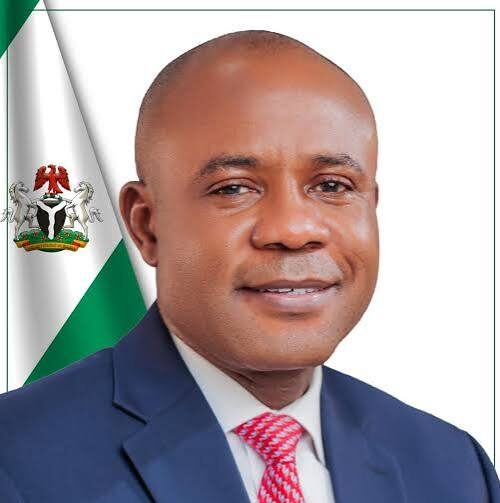
And at the centre of that message is Governor Peter Ndubuisi Mbah, a man who has turned economic re-engineering into a political statement.
Hosting editors for the second year in a row — a rare privilege for any state — Mbah did not reel out achievements.
He explained a philosophy.“Let me once again restate how grateful we are as government and people of Enugu to have the honour of hosting you for the second year in a row. We truly understand the value, and we do not take it for granted,” he told the editors.
“I’m interested to know what you saw. What surprised you? What disappointed you? What doesn’t add up?”It was vintage Mbah — confident, interrogative, data-driven.
The N406bn Shock
The biggest surprise for many editors was not the projects, but the numbers behind them. According to the governor, Enugu closed 2024 with N406 billion in revenue, up from N25 billion when he assumed office in 2023.
Today, the state ranks only behind Lagos and Rivers in Internally Generated Revenue, IGR.And it is the fastest-growing state in revenue generation in Nigeria.
But the statistic that dismantled the most common criticism of his government was this: less than 13 per cent of that IGR comes from taxation.
“We tell people that a lot of that doesn’t come from tax because there is this narrative that has been framed – that we’re overtaxing our people. It’s just a three part of it. Less than 13 per cent of our IGR comes from taxation,” Mbah said.
“Over 87 per cent we get from the businesses we’re building. We’ve activated all our moribund companies, and they are all running.”He listed them: United Palm Products, Sunrise Flour Mill, Niger Gas, Presidential Hotel, International Conference Centre, the modern transport terminals.For decades, these were symbols of waste — rusted gates, unpaid salaries, and white elephant commissions. Under Mbah, they have become cash cows and job centres. The strategy, he said, was simple: plug leakages, revive dead capital, and create new productive assets.
“We are making money from them. And that was our commitment to pluck the leakages and activate, revive all the moribund industry. And that’s where the revenue is coming from, not from taxation.”It is a model that flips the typical Nigerian sub-national playbook where governors raise IGR by raising taxes, levies and fines on already overburdened citizens.
Beyond Bricks: Projects As Means, Not End
What the editors saw on the tour tells the story of that model. The New Enugu City — 10,000 hectares of planned smart city — is not just a real estate project. It is a future tax base, a new economy.
The 7,000 smart green school classrooms, each with solar, digital boards, and furniture — 464,000 pieces procured — are not just schools. They are human capital factories.
“It’s almost, as I always say, insane. Doing over 7,000 classrooms within two and a half years. But when you hear 7,000 classrooms, it’s not even about the classroom. That doesn’t tell you the story about the 464,000 furniture items that we also had to procure,” Mbah explained.
“They are not for political acclaim. Our hope is that whoever comes after would have to build on what they see.”
This is perhaps the most radical part of Mbah’s pitch — designing projects to be politically irreversible.“Our intervention in education is not about the structure. If you go to any of the smart green schools, you see that the future tells a difference. It underscores the fact that our children are entering into a different world,” he said.
“Not the one we lived 40 years ago where we went to school with chalk and blackboard. We recognise that in designing the smart school to capture the evolving 21st century skills.”Once children experience experiential learning — robotics, digital labs, interactive screens — you cannot take them back to memorization and rote learning, he argued. Citizens themselves will demand continuity.
“We’re now doing the heavy lift. The capital expenditure we’re carrying now. We’re hoping that whoever comes subsequently will be focusing more on the operating cost. Which we know is sustainable.”
TOURISM AS ECONOMIC STRATEGYThe same logic drives his tourism push.Enugu Ranch, Pine Forest zip-line, Okpatu’s 5.6-kilometre cable car, the 2,000-year-old Nsude Pyramid being recast, and the 4,000-year-old iron smelting site at Lejja are not being preserved as cultural relics. They are being packaged as products.“Our investment in tourism is to help us attract 3 million people into Enugu. So, we’re currently doing six massive tourism sites,” Mbah said.For a state without oil, tourists are its crude.And to bring them in, Mbah entered aviation — floating Enugu Air to create connectivity. It was a controversial move at first, but the governor sees it as supply-chain logic: you cannot grow a destination if people cannot get there with ease.
The Blueprint: Keep Them Home
All of this, the governor insisted, connects back to a single campaign promise.“When we took office, we laid out a blueprint. One was to grow the economy of the state exponentially, but also to eradicate poverty and to create a state where people can live, work, invest and build futures,” he said.
“What I said to them when I was campaigning was that I was tired of seeing young people leave Enugu after their education to go elsewhere to look for work.”“The idea was for us to create something here that will keep people here so they can create wealth here, find employment, live here, have a satisfying life here without necessarily going out.
We don’t want our boys only to come back to Enugu when they want to attend funerals or weddings.”In that sense, the projects are not the end point. They are means — mutually reinforcing investments in security, transport, tourism, health and education designed to achieve one objective: exponential growth.
Security, Regional Integration And Federal Synergy
Editors pressed him on sustainability — how do you secure Enugu when the South-East remains volatile?
Mbah acknowledged no state can insulate itself, but said his administration has invested in border surveillance technology that gives it line of sight on every formal and informal entry point.“We can see you, we know you and we know when you’re leaving,” he said.
Beyond that, he is pushing for a peer-review mechanism among South-East governors — a common command and control centre for intelligence and operations to prevent criminals from migrating from one state to another when neutralised.
That regional integration is now getting federal backing through the newly operationalised South-East Development Commission, SEDC.“I think that we must commend the president for signing the SEDC into law,” Mbah said. According to him, the Commission has already taken ownership of two critical regional projects — a pressurised gas pipeline to all major South-East cities and an integrated South-East railway line — both of which were previously pursued in isolation.
On the aviation front, the international wing of the Akanu Ibiam International Airport has been concessioned to private investors to operationalise it as a true gateway for the region.
He also cited strong synergy with the Federal Government on roads — the 22km Enugu-Abakaliki dualisation by the state complemented by a federal flyover, and the Enugu-Onitsha and Enugu-Port Harcourt expressways which are now motorable.
The Editors’ Verdict
For many editors, the tour was déjà vu with a difference. They had seen some projects last year during the Guild’s conference in Enugu.
This year, they saw progress — schools completed, hospitals equipped, roads tarred. Veteran journalist and former Ogun State governor, Chief Segun Osoba, and NGE President Eze Anaba were among those who commended the transformation.
But the real test came during the interactive session. Editors questioned continuity, debt sustainability, and maintenance culture.
Mbah’s answer was philosophical: build standards so high that the people will not accept a reversal.It is a gamble that has worked in other parts of the world — where citizens defend quality because they have tasted it.
From N25 billion to N406 billion in two years, without squeezing traders, Enugu’s experiment is no longer just about infrastructure. It is about proving that a Nigerian state can grow its economy not by taxing poverty, but by producing wealth.
Whether it lasts beyond Mbah will be the true test. For now, the cranes are moving, the revenue is rising, and Enugu — the old coal city — is trying to mine a new kind of coal: productivity.