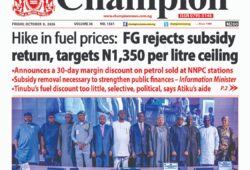


.Announces a 30-day margin discount on petrol sold at NNPC stations
.Subsidy removal necessary to strengthen public finances – Information Minister
. Tinubu’s fuel discount too little, selective, political, says Atiku’s aide
The Federal Government has rejected calls to restore fuel subsidy, saying such a move could worsen prices and destabilise the economy.
The Minister of Finance and Coordinating Minister of the Economy, Mr Taiwo Oyedele, said this at a High Level Strategic Engagement with Ministries, Departments and Agencies (MDAs) in Abuja.
The Minister of Information and National Orientation, Mohammed Idris, said the removal of fuel subsidy and other economic reforms embarked upon by the Federal Government are necessary to address structural distortions and strengthen public finances.
However, the media office of former Vice President Atiku Abubakar has criticised the Federal Government’s 30-day petrol discount programme at NNPC filling stations, describing the initiative as inadequate, selective and politically motivated.
Oyedele said that the recent rise in petrol prices was largely driven by the global conflict and disruptions in international energy supplies.
He said that Brent crude had risen above 100 dollars per barrel, while shipping through the Strait of Hormuz had fallen sharply.
According to him, petrol prices rose from about N830 to N1,400 per litre following the global energy shock.
Oyedele said that returning to subsidy would transfer the burden to government finances and potentially threaten salaries, pensions and public services.
He estimated that restoring petrol to its pre-reform price could cost more than N20 trillion annually.
The minister said that even fixing petrol at N500 per litre would cost the government over N16 trillion annually.
Oyedele said that subsidy removal released N15.8 trillion to the Federation Account between June 2023 and December 2025.
He said that N10.4 trillion of the amount went to state and local governments, improving their ability to meet financial obligations.
Oyedele said that the government had granted tax and duty waivers on petroleum products, saving consumers between N400 and N600 per litre.
He said the waivers represented more than N5 trillion in potential tax revenue, while petrol remained cheaper than in several African countries.
The minister said that the government was also promoting local refining, Naira-for -crude transactions and compressed natural gas as alternatives.
He said that more than 120,000 vehicles now ran on CNG, supported by over 400 conversion centres and 96 refuelling stations.
According to him, more than 550 CNG buses have been deployed, with fares falling by 30 per cent to 50 per cent where they operate.
He announced a 30-day margin discount on petrol sold at NNPC stations, prioritising public transport operators nationwide.
The minister also disclosed plans to negotiate a N1,350 per litre ceiling on petrol ex-gantry or landing costs.
He said that the ceiling would be reviewed monthly to reduce price volatility without reintroducing fuel subsidy or imposing permanent price controls.
Oyedele said that government would also increase cash transfers, subsidised credit and accelerate CNG deployment to support vulnerable Nigerians.
He announced plans to consider an excess profit tax on energy operators taking undue advantage of consumers.
“Proceeds will support transport assistance or vouchers for vulnerable urban minimum-wage earners,” he said.
The minister also announced plans for a National Strategic Fuel Reserve to protect consumers against future supply disruptions.
He said that the reserve would release refined products during major disruptions or hoarding, without fixing market prices.
He said the government was also working with states to eliminate illegal levies contributing to higher transport and logistics costs.
The minister assured Nigerians that the government was developing comprehensive fiscal measures aimed at reducing inflation to single digits sustainably.
“We can not afford to live through the previous cycle of scarcity, smuggling, currency weakness and fiscal crisis,” he said.
Oyedele said that the government’s priority was to preserve economic reforms while ensuring their benefits reached Nigerians more quickly and tangibly.
Speaking in a similar vein at a news conference, themed “Fuel Prices and the Subsidy Question”, organised by the Ministry of Finance, Idris said the reforms were introduced in response to long-standing economic challenges confronting the country and the need to reposition the economy on a stronger and more sustainable foundation.
According to him, the administration of President Bola Tinubu has embarked upon some of the most consequential reforms in Nigeria’s recent history.
He identified the removal of fuel subsidy as one of the major reforms undertaken by the administration to address distortions that had affected the economy over the years.
“It was in response to the long-standing economic challenges that the administration of President Bola Tinubu embarked on some of the most consequential reforms for our recent history.
“This includes the removal of the fuel subsidy and other reforms that the President has embarked upon.
“These reforms were necessary to address structural distortions, strengthen public finances and redirect national resources towards critical priorities that support sustainable growth and development.
“Three years down the road, the results are increasingly evident. The economy is today on a stronger footing than it was when President Bola Tinubu took office in May of 2023,” he said.
He attributed the emerging economic stability to the strong foundation laid by the administration through its reform measures.
Idris said the reforms had created sufficient fiscal headroom for investment and provided opportunities for enterprises to flourish in the country.
He recalled that President Tinubu, in his Independence Day broadcast about a week earlier, described the current phase as a transition from economic reforms to prosperity.
The minister said the focus of government was now shifting towards ensuring that the gains of the reforms were translated into tangible benefits for ordinary Nigerians.
He said the objective was to ensure that the benefits of economic reforms were felt on the dining tables of Nigerians and by everyone living in the country.
Idris added that the government was also working to create a stronger environment for businesses to thrive and contribute to national economic development.
He said the administration remained committed to achieving lower living costs and improving the overall quality of life of Nigerians.
The minister acknowledged that more work must be done, stressing that the direction of the government’s economic policies was becoming increasingly clear.
He said the administration’s goal was to build an economy driven by production, investment and enterprise rather than one dependent on unsustainable interventions.
According to him, progress should be measured not only through economic indicators but also by the opportunities available to young Nigerians.
He said the strength of businesses, productivity of farms and industries, as well as the general living standards of Nigerians, should form part of the measures of economic progress.
Idris said the media had an important role to play in helping Nigerians understand the economic reforms, their impact and the challenges that remained.
He urged journalists to integrate facts, ask necessary questions and provide accurate information on the progress being made by the country.
The minister also encouraged the media to report the challenges associated with the reforms responsibly while helping citizens understand the broader national economic situation.
He stressed that Nigeria belonged to all citizens and urged the media to ensure that its activities promoted national unity, progress and prosperity.
Idris called on journalists attending the conference to listen attentively, interrogate the issues, ask questions and make constructive comments, stressing that the fuel price and subsidy debate was ultimately about the future of Nigeria.
In a statement issued on Thursday, the Atiku Media Office said the temporary intervention appeared to contradict the Tinubu administration’s longstanding position that petrol subsidy had been removed permanently.
The statement recalled that Atiku had previously advocated a transparent, production-based subsidy aimed at making locally refined petrol more affordable, but alleged that the proposal was dismissed by the administration and its supporters.
“Today, the same administration is announcing government-negotiated price ceilings, discounted petrol sales and arrangements to cushion consumers against market fluctuations,” the statement said, questioning whether the policy shift was driven by economic realities or the approach of the 2027 general elections.
While welcoming measures that could reduce the burden on Nigerians, the Atiku camp argued that the intervention would have limited impact because access to the discount would depend largely on the availability of NNPC retail outlets.
The statement noted that NNPC Retail has more than 900 outlets nationwide, but argued that their distribution was uneven and questioned how Nigerians living in communities without NNPC stations would benefit.
It also cited what it described as an NNPC July 2026 report putting petrol availability across the company’s retail network at 52 per cent.
The former vice president’s media office questioned how the government could provide meaningful nationwide relief through a network that, according to the statement, had struggled to maintain consistent petrol availability.
Subsidy Debate
The statement also challenged the government’s description of the proposed intervention as neither a subsidy nor a price control.
It cited Finance Minister Taiwo Oyedele’s position that the measures would not amount to a subsidy, while arguing that government efforts to establish a price ceiling and arrangements for refiners and importers to recover potential shortfalls raised questions about who would ultimately bear the cost.
“An intervention that transfers costs, postpones their recovery or uses public resources to make petrol cheaper raises legitimate subsidy-related questions that cannot be dismissed by changing its name,” the statement said.
The Atiku camp further argued that Nigerians needed a long-term reduction in petrol prices rather than a 30-day intervention.
It renewed its call for what it described as a production-based subsidy, involving transparent and targeted crude-pricing arrangements for domestic refiners.
According to the statement, such a policy could support local refining, reduce production costs and ensure that savings were passed on to consumers nationwide.
It also pointed to discussions within the Tinubu administration on forward crude sales to domestic refiners as evidence, in its view, that production-side interventions should receive greater consideration.
“The Tinubu government cannot condemn Atiku’s proposal in September and embrace the logic of petrol-price intervention in October while pretending there is no contradiction,” the statement said.
Call for Transparency
The Atiku Media Office called on the Federal Government to publish details of its proposed petrol price-modulation arrangement, including its financial implications and the NNPC outlets participating in the programme.
It also asked the government to explain how the intervention would translate into lower transport fares, reduced food prices and broader improvements in the cost of living.
The statement linked the petrol intervention to recent comments by Daniel Bwala, Special Adviser to President Bola Tinubu on Policy Communication, concerning the impact of the administration’s economic reforms on poverty.
It said Bwala had acknowledged on Channels Television’s Politics Today that more Nigerians had fallen into poverty as a consequence of the reforms.
Against that backdrop, the Atiku media office questioned why the administration was only now considering measures to cushion Nigerians from rising costs.
“The question is no longer whether Nigerians are suffering. Even the Presidency has acknowledged it,” the statement said.
It urged the government to prioritise citizens’ welfare over what it described as political calculations ahead of the 2027 elections.
The statement also compared the current administration’s economic performance with that of the 1999–2007 period, arguing that fuel subsidy was not removed and taxes were not increased during that era, yet Nigeria’s economy grew to become Africa’s largest.
“Policies are made for the welfare of people. People are not created to suffer for the sake of policies,” the statement said.
For a better society
_______________________________
Follow us across our platforms:
Instagram – https://www.instagram.com/championnewsonline/
Facebook – https://web.facebook.com/championnewsonline
LinkedIn – https://www.linkedin.com/company/champion-newspapers-limited/
https://x.com/championnewsng/
You can also like and comment on our YouTube videos.
https://youtu.be/QIBfD1tT80w?si=R4Qf3so2LxYu3GC2