
. Plans free data for students on learning platforms
Favour Ishember, Abuja and agency report
The Federal Government has said it will soon end the slaughtering of livestock in uncontrolled environments across the country as part of efforts to modernise the red meat industry and position Nigeria for the export market.
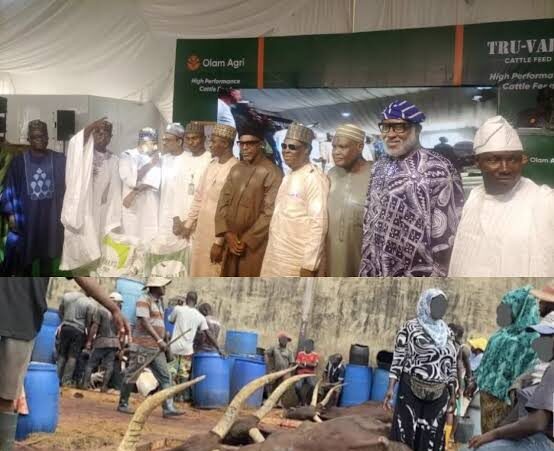
The Minister of Livestock Development, Idi Mukhtar Maiha, disclosed this on Thursday in Kaduna at the official launch of Olam Agri’s TruValue Cattle Feed, a beef and dairy concentrate feed.
Maiha said the government had already commenced the development of modern abattoirs and would require animals destined for the market to pass through feedlots and meet prescribed standards before slaughter.
He said, “We are going to sustain the tempo to ensure that in the not too distant future, we will stop trading in live animals, and every slaughtered animal in this country must be done under the controlled environment of a modern abattoir.”
According to him, the government had already conducted groundbreaking ceremonies for two abattoirs and a mini abattoir in the Offa axis, while another facility under construction in Abuja would have the capacity to process 1,000 bulls and 3,000 small ruminants daily.
He explained that the development of feedlots, modern slaughter facilities, meat processing plants and cold-chain infrastructure would enable Nigeria to produce quality and traceable meat for both domestic consumption and export.
The minister said, “For them to meet the specification, these animals will have to pass through a feedlot—whether it’s a ram, a goat, a pig, a camel, or a bull. Standards have to be introduced, and this will be enforced.”
Maiha described the launch of TruValue as timely, saying availability of quality and affordable feed remained one of the major constraints to livestock productivity and a factor contributing to conflicts involving farmers and herders.
He said adequate feed supply throughout the year, whether through fodder, crop residue or concentrates, was critical to achieving peace, improving animal productivity and making livestock farming commercially viable.
“Feed remains one of the most significant constraints to livestock productivity in Nigeria. It is undoubtedly at the root cause of the current farmer-herder crisis in this country,” he said.
Maiha said balanced feed could improve weight gain, shorten finishing periods and increase profitability for farmers, particularly when combined with quality fodder, clean water and proper animal husbandry.
He also disclosed that Nigeria had potential buyers for its red meat from the Gulf, Middle East and Egypt, adding that the country must take advantage of the opportunity by improving production and quality standards.
“Today we have a lot of offtakers waiting for Nigerian red meat. I have met several potential offtakers from the Gulf, from the Middle East, including Egypt. And I do believe the African market too is going to rely on us ultimately,” he said.
The minister said the National Livestock Growth Acceleration Strategy, approved by the National Economic Council, was designed to increase the livestock sector’s contribution from $32bn to $74bn within 10 years.
He added that the forthcoming Nigerian Livestock Economic Advancement Programme, N-LEAP, would create an ecosystem involving producers, financiers, insurers, breeders, aggregators and marketers.
Maiha also sought to dispel concerns over the Federal Government’s Livestock Development Centres, stressing that the initiative was not about taking land from states or communities.
He said states would determine the livestock value chains suitable for their ecological zones and voluntarily allocate land after stakeholder consultations.
“No government, nobody, least of all under this present regime, is going to take land from anybody. The states decide what they want to do,” he said.
Representing Kaduna State Governor, Uba Sani, the Special Assistant on Land Resources, Umar Ismail, described the launch as a potential turning point for Nigeria’s cattle feed industry.
Ismail said Olam Agri’s intervention in the livestock sector was aligned with the government’s ambition to transform livestock production into a major economic driver.
He said the company had invested $150m in Nigeria since entering the feed business nine years ago, with operations covering poultry and fish feed production.
According to him, the poultry industry had grown significantly since the company’s intervention, while the cattle sector remained largely traditional and was now ripe for transformation.
“But I think it is now ripe for an intervention. It is ripe for taking this big leap forward, organising itself, and becoming a powerhouse for future economic development for a lot of traditional farmers across different parts of the country, especially in Northern Nigeria.”
Earlier in his remarks, The Vice President, Agriculture, Olam Agri, Sameer Wadhera, has said, Nigeria would require 115 per cent more beef and 575 per cent more milk by 2050 to meet the demands of its projected population of nearly 400 million.
Sameer said Nigeria, which has about 24 million cattle, possessed the largest cattle herd in West Africa and the fourth largest in Africa, describing the livestock industry as a “sleeping giant” waiting to be awakened.
According to him, the projected population growth makes increased livestock productivity imperative if the country is to avoid depending increasingly on imports to bridge its protein deficit.
He said, “We are projected to have a population of close to 400 million by 2050. With this population increase, we will need to feed people, and we will need a minimum of 115 per cent more beef in the country, 575 per cent more milk in the country.”

Meanwhile, the Federal Government has rolled out a sweeping data-free learning programme that will allow millions of senior secondary and university students to access approved learning platforms without spending a kobo on internet data.
Unveiled in Abuja on September 10, 2026, the Initiative for Zero-Rated Access to Educational Platforms and Content in Nigeria is being driven under President Bola Tinubu’s Renewed Hope Agenda by the Minister of Education, Dr. Tunji Alausa.
Taking his cue from the reality on the ground, Dr. Alausa said the programme is about more than just internet access, saying “It’s about bringing education directly to children who previously couldn’t afford the data to log on.”
According to him, once cost is out of the way, a smartphone, tablet or laptop instantly becomes a classroom, a library, and a door to new opportunities. Especially for students from low-income homes and communities with few physical schools.
“Poverty, location and the price of connectivity will no longer decide who gets quality education,” the Minister stated at the launch.
The zero-rating drive sits inside a larger overhaul of the sector through the Nigeria Education Sector Renewal Initiative, NESRI. At its foundation are three digital pillars: the Nigeria Education Data Infrastructure, the Digital Nigeria Education Management Information System, and the Learner Identification Number.
Dr. Alausa said these tools will help government plan, track and deliver education better, but added that real success will be measured by how many learners actually benefit and how much learning improves.
The Minister said protecting the welfare and dignity of Nigerian children remains a priority under President Tinubu. To that end, the government is working toward regulated internet access for all children under 16, as part of efforts to shield them from cyberattacks and other online dangers.
Dr. Alausa also called on the telecoms sector to treat connectivity like a basic learning tool ; as important as classrooms, textbooks and labs.
He urged joint action by the Ministry, State Governments, the Nigerian Communications Commission, telecom operators, tech firms, development partners, schools and teachers to make digital learning affordable, safe and useful.
Beyond that, he said Nigeria must shift from raising “technology consumers” to raising “technology creators” young people who can innovate, solve problems and compete globally.
Dr. Alausa assured that the Federal Ministry of Education will keep working closely with the NCC, states, telecom operators, schools, and partners to turn the initiative into long-term gains for learners.
He reaffirmed the Ministry’s commitment to Tinubu’s Renewed Hope Agenda by tearing down barriers to learning, widening access, and using technology to build a system where a child’s postcode doesn’t decide their future, poverty doesn’t shut them out of knowledge, and every Nigerian student can reach their full potential
In his remarks, Hon. Peter Akpatason, Chairman of the House Committee on Communications, praised the NCC for backing the initiative.
He described expensive data as one of the biggest roadblocks to digital learning today, and pledged that the House of Representatives will back policies and laws that use technology to close the education gap, especially in hard-to-reach areas.
Senator Mohammed Muntari Dandutse, Chairman of the Senate Committee on Tertiary Institutions and TETFund, echoed that message. He said no Nigerian child should be denied knowledge and applauded telecom companies for supporting students through CSR programs, noting that access to information is key to national progress.
For a better society
_______________________________
Follow us across our platforms:
Instagram – https://www.instagram.com/championnewsonline/
Facebook – https://web.facebook.com/championnewsonline
LinkedIn – https://www.linkedin.com/company/champion-newspapers-limited/
https://x.com/championnewsng/
You can also like and comment on our YouTube videos.
https://youtu.be/QIBfD1tT80w?si=R4Qf3so2LxYu3GC2