

.Says FG committed to delivering tangible benefits to Nigerians
.As CBN, economists project faster growth rate, lower inflation
.NESG canvasses consolidation of economic gains for sustainable growth
Nigeria’s headline inflation rose to 15.15% in December 2025, as against the 14.45% recorded in November, according to the National Bureau of Statistics (NBS).
While the month-on-month headline rate saw a 0.7% increase, the food sub-index offered a slight reprieve, dropping from 11.08% to 10.84%.
The NBS noted that this inflationary shift was primarily driven by a methodological adjustment following the recent rebasing of the Consumer Price Index (CPI).
“The Consumer Price Index (CPI) rose to 131.2 in December 2025, up by 0.7 points from the previous month (130.5),” the report stated.
The December 2025 year-on-year headline inflation rate stood at 15.15%, relative to the November 2025 headline inflation rate of 17.33%.
“The December 2025 year-on-year Headline inflation rate stood at 15.15% relative to the November 2025 headline inflation rate (17.33%).
“On a year-on-year basis, the December Headline inflation rate was 19.65% lower than the rate recorded in December 2024 (34.80%),” the report added.
This shows that the headline inflation rate (year-on-year basis) decreased in December 2025 compared to the same month in the preceding year.
The NBS clarified that the December figures reflected a change in methodology, using a twelve-month index reference period with the average CPI for 2024 set to 100, rather than a single-month reference base.
“This shows that the Headline inflation rate (year-on-year basis) decreased in December 2025 compared to the same month in the preceding year (i.e., December 2024), though with a different base year, November 2009 = 100,” the report stated.
On a month-on-month basis, headline inflation moderated to 0.54% in December from 1.22% in November, indicating easing short-term price pressures.
The NBS attributed the change in methodology to align with international best practices under the IMF Consumer Price Index Manual and the ECOWAS Harmonised CPI framework.
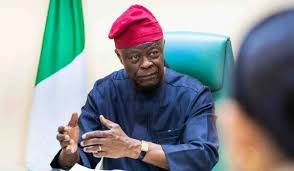
Meanwhile, Minister of Finance and Coordinating Minister for the Economy, Mr Wale Edun, says the economy is projected to grow 4.68 per cent in 2026 as the government drives investment-led, inclusive growth aimed at creating jobs and boosting citizens’ welfare.
Edun made the remarks on Thursday in Lagos while delivering the keynote address at the launch of the Nigerian Economic Summit Group (NESG) Macroeconomic Outlook Report for 2026.
He said the growth projection aligns with the government’s medium-term goal of achieving seven per cent annual growth and building a one-trillion-dollar economy by the end of the decade.
According to Edun, the economy in 2026 is projected to grow at 4.68 per cent, consistent with our path to seven per cent growth per annum and a one-trillion dollar economy by 2030.
He projected average inflation at 16.5 per cent and the exchange rate at about N1,400 per dollar.
“For inflation, as we have said, we need to get into simple figures. It is expected to average 16.5 per cent and the exchange rate, N1,400 per dollar,” he said.
Edun noted that the 2026 budget, titled “Budget of Consolidation, Renewed Resilience and Shared Prosperity,” reflects President Bola Tinubu’s commitment to ensuring that macroeconomic improvements translate into real gains in Nigerians’ daily lives.
“It is not about the metrics or the percentages; it is about the lived experience of Nigerians in terms of electricity supply, food availability and improved welfare,” he said.
He said the budget deficit, estimated at about four per cent of Gross Domestic Product (GDP), reflected the scale of Nigeria’s development needs and the ambition to accelerate growth.
Edun emphasised that following the removal of distortions and recent stabilisation measures, the focus of economic policy had shifted to driving growth through increased investment.
“Ongoing investments in digital infrastructure, including the rollout of over 90,000 kilometres of fibre optic cables in collaboration with the World Bank and the Ministry of Communications are part of efforts to empower young Nigerians and support technology-driven growth,” he said.
The minister said the reform programme was anchored on four objectives.
“These include: consolidating macroeconomic stability, improving the business and investment climate, strengthening human capital while protecting the vulnerable through social protection, and stimulating broad-based economic growth,” he noted.
On fiscal performance, Edun said that even with shortfalls in oil and gas revenues compared to budgeted levels, the Federal Government prioritised fiscal federalism, transparency, and accountability in managing the federation account.
“This ensured that funds due to states and sub-national governments were fully disbursed, significantly strengthening their financial positions,” he said.
He added that many states recorded budget surpluses of about three per cent, enabling increased spending on health, education, public services, and other social and economic priorities.
Edun also highlighted that the Federal Government demonstrated fiscal discipline by extending the 2024 budget to ensure the completion of priority capital projects.
“Aggregate capital expenditure in 2024 stood at about N11.1 trillion, representing an 85 per cent performance, reflecting the administration’s emphasis on completing ongoing projects,” the minister explained.
He said all statutory obligations, including foreign and domestic debt servicing as well as salary payments, were fully met.
“These outcomes underscore a strong commitment to transparency, structural reform and fiscal discipline, as well as laying the foundation for rapid, sustained and inclusive growth,” Edun added.
He noted the government’s long-term growth target of seven per cent was aimed at outpacing population growth and lifting millions of Nigerians out of poverty.
The minister explained that reducing reliance on debt was a key fiscal priority, with renewed emphasis on boosting government revenue through digitalisation, central billing systems, and improved reconciliation processes to block leakages.
“The introduction of a central billing and receipt system would enhance transparency by tracking assessments and payments in real time across government agencies,” he said.
Edun also highlighted the implementation of a new tax law designed to be pro-poor, broaden the tax base, simplify compliance, and exempt essential goods, food items, and small businesses.
He said President Tinubu’s strategic vision was to build a resilient, diversified, and globally competitive economy, leveraging exchange rate stability and expanded trade opportunities under ECOWAS and the African Continental Free Trade Area.
Edun identified key priorities for 2026 to include improving competitiveness through sound governance, boosting agricultural productivity and food security, accelerating infrastructure and energy development, and investing in human capital.
He acknowledged constraints in global concessional financing and said Nigeria must increasingly rely on domestic resource mobilisation and private sector investment to fund development.
Edun urged Nigerians at home and in the diaspora to take advantage of improved macroeconomic conditions to invest in the economy.
“The private sector is indispensable to sustaining growth,” he said.
Edun said although the task ahead was challenging, the Federal Government remained resolute in translating economic stability into inclusive, job-rich growth.
“We remain committed to delivering tangible benefits to the average Nigerian,” he stressed.
.As CBN, economists project faster growth rate, lower inflation
However, The Central Bank of Nigeria (CBN) and leading economists have projected stronger economic growth and lower inflation in 2026, citing improved macroeconomic fundamentals and reform impacts.
The projection was made on Thursday at a hybrid roundtable organised by the Chartered Institute of Bankers of Nigeria Centre for Financial Studies with B. Adedipe Associates.
The Lagos event was the theme ’12th Edition National Economic Outlook: Implications for Businesses in Nigeria in 2026′.
CBN Deputy Governor, Economic Policy Directorate, Dr Muhammad Abdullahi, said real GDP growth was projected at 4.49 per cent in 2026.
He added that inflation was expected to moderate to 12.94 per cent, reflecting easing pressures and reform outcomes.
Abdullahi said the outlook was supported by non-oil sector expansion, improved crude oil output, rising private investment and a more stable macroeconomic environment.
He said Nigeria recorded a balance of payments surplus of about 3.81 billion dollars in 2025, reversing deficits from the previous two years.
According to him, foreign exchange conditions would remain broadly stable due to FX reforms, higher oil receipts, diaspora remittances and stronger investor confidence.
“External reserves are projected to exceed 50 billion dollars in 2026,” he said, adding that inflation would continue easing.
He attributed the trend to lower food and energy pressures and the lagged effects of monetary tightening.
Abdullahi, represented by Dr Victor Oboh, Director, Monetary Policy, said the apex bank would sustain reforms to strengthen price stability and external sector resilience.
He urged banks to expand credit to productive sectors, including manufacturing, agribusiness and small and medium enterprises.
Keynote speaker, Prof. Biodun Adedipe, Chief Consultant of B. Adedipe Associates Ltd ., said the economy was expected to perform better in 2026 than in 2025.
He described 2026 as a stabilisation year marked by exchange rate stability, declining inflation, rising reserves and strong stock market performance.
Adedipe said Nigerians were already feeling reform impacts, noting easing prices of some staple foods.
He called for sustained policies to boost production, particularly agriculture, to further reduce inflation.
Also speaking, Dr Baba Musa, President of the Nigerian Economic Society, said Nigeria’s economic fundamentals were improving, but outcomes depended on reform execution.
“Effective monetary, fiscal and tax reforms will determine 2026 outcomes,” he said, urging businesses to invest in capacity, technology and markets.
Earlier, Prof. Pius Olanrewaju, Chairman, Council of the CIBN, said the forum set the tone for economic policy dialogue in 2026.
He said new tax reforms effective Jan. 1 would broaden the tax base, strengthen public finances and reduce oil dependence, while protecting small businesses and low-income earners.
…NESG canvasses consolidation of economic gains for sustainable growth
Also, The Nigerian Economic Summit Group (NESG) has called on government, industry leaders, and stakeholders to consolidate recent economic stabilisation gains, warning that stability alone is insufficient to deliver prosperity.
Speaking at the launch of the 2026 Macroeconomic Outlook, on Thursday in Lagos. the NESG Chairman, Mr Niyi Yusuf, said Nigeria had emerged from one of the most challenging adjustment periods in its recent economic history.
He said the focus must now shift to translating stability into inclusive growth.
The theme of the programme was “Consolidating Economic Stabilisation Gains: Pathway to Sustainable Growth in Nigeria,”
Yusuf said that the economy grew by 3.8 per cent in the first nine months of 2025, up from 3.2 per cent in the same period of 2024, driven largely by services sectors such as financial services, transport, and ICT.
“Industrial output expanded nearly five per cent, supported by oil, gas, and construction activities, while headline inflation moderated from over 33 per cent in 2024 to around 21 per cent in 2025.”
However, the NESG chairman noted persistent structural challenges.
He said manufacturing remained constrained by high energy costs and limited access to foreign exchange, agriculture output lags due to insecurity and rising logistics costs.
He explained that household purchasing power remained weak, affecting trade activity.
“Stabilisation is a necessary condition for growth, but it is not sufficient.
“The critical question is how we consolidate these gains so that economic growth translates into improved welfare, jobs, and productivity,” he said.
Yusuf explained that consolidation required coherent policies, institutional strengthening, and deliberate removal of bottlenecks that constrained output, investment, and competitiveness.
Yusuf emphasised the need to maintain reform momentum, warning that reform reversal would be far more costly than temporary reform fatigue.
The 2026 Macroeconomic Outlook launch also featured the soft launch of the National Industrial Policy by the Federal Ministry of Industry, Trade and Investment, as well as commentary on the December Inflation Report by Prince Adeyemi Adeniran, the Statistician-General of the Federation.
Yusuf described these events as evidence of strengthened public-private sector collaboration aimed at sustaining economic growth.
He urged all stakeholders to ensure that the sacrifices made during the stabilisation phase translate into opportunity, productivity, and shared prosperity for Nigerians.
For a better society
Follow us across our platforms:
Instagram – https://www.instagram.com/championnewsonline/
Facebook – https://web.facebook.com/championnewsonline
LinkedIn – https://www.linkedin.com/company/champion-newspapers-limited/
https://x.com/championnewsng/
You can also like and comment on our YouTube videos.
https://youtu.be/QIBfD1tT80w?si=R4Qf3so2LxYu3GC2