
.Climate action stuck between decarbonization and energy transition
.Nigeria remains firm on energy security, emission abatement
Sopuruchi Onwuka
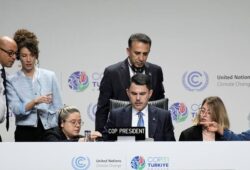
Despite over two weeks of intense discussions and deal making negotiations by over 200 parties, observers and environmental groups, the 31st Conference of Parties (COP31) in Antalya, Türkiye, ended in a major setback for global climate diplomacy.
By the closure of negotiations on Sunday, some 200 country parties failed to reach a consensus on a joint declaration to accelerate emissions reductions; exposing deepening divisions between industrialised nations, climate activists and developing countries over the future of fossil fuels, climate financing and the pace of the global energy transition.
With over 100,000 delegates, media representatives, community groups, climate activists and sundry interest groups that flooded Antalya across the weeks for what was expected to be “implementation COP,” parties failed to close their position gaps, leading to an embarrassing impasse.
The polarization of camps, Daily Champion reports, reflects a broader disagreement among parties over whether climate action should prioritise rapid elimination of fossil fuels or focus on reducing emissions through technology, cleaner production systems and gradual energy diversification.
Daily Champion reports that Nigeria and some other developing countries stand at the crossroads of the climate impasse, receiving the harsh climate impact on the one hand while relying on fossil energy as critical revenue and energy source to finance energy transition, economic growth, climate resilience and energy security.
Nigerian National Petroleum Company (NNPC) Limited which participated in the country party to the climate debate maintained at several panels at the event that it is leading players in the nation’s energy sector to drastically cut emissions through high operating standards, vigilance on fugitive methane emissions, asset integrity, flare gas commercialization, carbon capture and storage, and enhanced emission reporting standards.
The summit presented an opportunity for Nigeria to reinforce its position that climate action must be pursued alongside energy security, economic growth and industrial development; particularly as the country seeks to expand oil and gas production, develop its gas resources, attract investment and address persistent energy poverty.
Delegates from NNPC Limited emphasised the need for a balanced and pragmatic approach to the energy transition, stressing that developing countries must not be forced into pathways that undermine their economic development or compromise access to reliable and affordable energy.
The NNPC delegation maintained that decarbonisation of the petroleum industry should be pursued through practical measures that reduce emissions from exploration, production, processing and transportation while sustaining the industry’s contribution to national development.
Nigeria’s position aligns with the argument that the global energy transition must recognise the different circumstances of countries, particularly those with large populations lacking access to electricity and clean energy, inadequate infrastructure and limited capacity to finance new technologies.
The company’s delegates highlighted the importance of reducing operational emissions, improving methane monitoring and abatement, deploying cleaner technologies, strengthening emissions measurement, reporting and verification systems, and promoting investments that can deliver tangible environmental benefits without undermining energy supply.
They also stressed the role of natural gas in Nigeria’s energy transition, arguing that the resource could support cleaner power generation, industrial development, improved energy access and the integration of renewable energy, while providing a pathway towards lower-carbon economic growth.
According to them, climate commitments must be backed by accessible financing, technology transfer, international partnerships and capacity building, particularly for developing economies whose transition plans are constrained by capital crunch, infrastructure deficits and technological limitations.
Managing Director of NNPC Foundation, Mr Chinedu Eze Igwe, led debates that centered on Accelerating Global Methane Mitigation, a World Green Economy Organization (COP31 WGEO) event hosted by the Oil and Gas Decarbonization Charter (OGDC), whose signatories, including Nigeria, have invested significant $28 billion in low carbon solutions.
Member countries have in the past year also trained over 1,800 staff and engineers on methane and flaring reduction actions plans while advancing measurements and strengthening delivery through increased emission mitigation.
Mr Chinedu Igwe stated that NNPC Limited is creating emission reporting standards as part of strategies to create industry-wide consciousness on low emission operations.
He stated that the national oil company is underway to reposition players and their contractors for new operating procedures that emphasize emission vigilance and containment contingencies. He added that NNPC Limited continues to lead reporting standards and ensure that partners comply to emission transparency.
The highpoint of the event was the signing of a non-binding Memorandum of Understanding (MOU) between Nigeria and the United Kingdom on Energy Security and Transition.
Minister of State for Foreign Affairs, Ambassador Sola Enikanolaiye, who signed the pact on behalf of the Nigerian government, stated that Nigeria and other developing countries must be allowed to lead delivery of their climate action commitments.
He expressed Nigeria’s commitment to continue driving climate action and programmes without external pressure, adding that the country would continue implementation of its determined climate remediation contributions in a manner that does not jeopardize the nation’s economic and development aspirations.
Manager in charge of Sustainability, Strategy, Standards and Policy at NNPC Limited, Mr Philemon Yilleng, also participated in a side panel debate on Decarbonising Africa’s Value Chain: the Role of National Energy Companies, Finance and Strategic Partnerships.
Mr Yilleng also participated in a scheduled event by the Organization of Petroleum Exporting Countries (OPEC) on decarbonizing petroleum industry operations.
Later, the company’s panelist, Mr Ikechukwu Aturuobi, participated in a BCG at the COP31 Leaders Roundtable on Delivering Methane Emissions Reduction across Waste and Energy.
The positions canvassed by the NNPC technocrats reinforced Nigeria’s advocacy for a climate framework that recognises the need to reduce emissions while preserving the ability of resource-rich developing countries to utilise their natural endowments to fund development, expand energy access and improve living standards.
The broader message from the Nigerian delegation was that climate action should not be reduced to the elimination of fossil fuels but should focus on measurable emissions reductions, responsible energy production, cleaner technologies and sustainable development pathways that accommodate the realities of emerging economies.
In all the events, however, different countries, environmental groups and civil society organizations remained polarized on the best path to global consensus on halting and possibly reversing global warming through emission abatement measures. Yet, position gaps kept widening during debates and negotiations.
Unfortunately, the summit, which extended beyond its scheduled closing date as negotiators struggled to reconcile competing positions, ended without the adoption of the proposed “Antalya Pact” after the European Union and several other countries rejected the final draft for failing to explicitly address the transition away from fossil fuels.
The collapse of the agreement marked an unprecedented outcome in the history of the United Nations climate negotiations, with the conference plenary returning a “not adopted” verdict on the proposed declaration after weeks of negotiations and overnight diplomatic engagements failed to bridge the widening gulf between countries.
The disagreement forms the key outcome of the omission of references to oil, gas and coal, as well as any commitment to phase down or phase out fossil fuel consumption from the final draft presented by the Turkish-Australian conference leadership.
The revised text, which had earlier contained language on transitioning away from fossil fuels in energy systems, was reportedly stripped of explicit references to fossil fuels, coal, oil and gas; leaving only a broad commitment to transition towards low greenhouse gas emissions and climate resilience.
The European Union, Germany, France, Switzerland, Panama and several vulnerable nations rejected the text, arguing that it represented a retreat from commitments made at COP28 in Dubai, where countries agreed for the first time to transition away from fossil fuels in energy systems.
The EU insisted that a climate agreement that failed to identify fossil fuels as the principal drivers of global warming could not provide the decisive response required to address the escalating climate crisis.
Several European delegates argued that the omission undermined the credibility of the global climate process at a time when rising temperatures, extreme weather events and climate-related disasters were intensifying across continents.
Climate activists and environmental organisations also condemned the draft, accusing major oil-producing countries and fossil fuel interests of exerting undue influence over negotiations and obstructing efforts to secure a binding roadmap for reducing dependence on hydrocarbons.
Panama’s Environment Minister, Juan Carlos Navarro, was among the most outspoken critics, declaring that COP31 had been “hijacked by petroleum” and calling for reforms to the UN climate negotiation process to allow decisions to be taken by majority vote rather than consensus.
He argued that the consensus-based system had enabled a handful of countries to frustrate the aspirations of more than 130 nations seeking stronger climate action, insisting that the conference should not become a platform for protecting the interests of petroleum producers and consumers at the expense of the planet.
The frustration among climate advocates was heightened by the removal of other provisions from the draft agreement, including references to phasing out inefficient fossil fuel subsidies, clean electrification, a just transition mechanism and the health benefits of climate mitigation. References to air pollution and the need for rapid and substantial methane reductions were also reportedly weakened or removed.
Environmental campaigners further criticised the conference’s growing emphasis on carbon capture and storage technologies, arguing that the approach was being promoted as an alternative to direct emissions cuts and could prolong the use of fossil fuels rather than accelerate their displacement.
However, the resistance to fossil fuel phase-out language was equally rooted in the concerns of developing countries and oil-producing nations, which argued that the transition to a low-carbon economy must not be pursued at the expense of energy security, economic development, industrialisation and access to affordable energy.
Countries dependent on oil, gas and coal revenues maintained that a global transition cannot be imposed through uniform timelines without accounting for differences in national economic structures, development priorities, energy resources and technological capacities.
Oil-producing countries, including Nigeria, Saudi Arabia and Russia, resisted stricter language on fossil fuels, arguing that the negotiations should focus on emissions reduction rather than prescribing the elimination of specific energy sources.
They backed carbon capture, utilisation and storage technologies as part of a strategy to reduce the environmental impact of continued fossil fuel use while preserving energy supply.
The differing positions of parties reflected a broader disagreement over whether climate action should prioritise rapidly eliminating fossil fuels or focus on reducing emissions through technology, cleaner production systems and gradual energy diversification.
Developing nations also expressed frustration over the failure of industrialised countries to provide adequate climate financing to support adaptation, resilience and low-carbon development.
African countries and other vulnerable economies argued that they were being asked to shoulder the consequences of a climate crisis largely driven by historical emissions from industrialised nations, without receiving the financial resources required to protect communities, infrastructure, agriculture and livelihoods.
Daily Champion reports that the disagreement over climate financing has been a major obstacle to consensus, with African delegates pressing for stronger commitments from wealthy countries to scale up adaptation finance and fulfil existing pledges.
The proposed declaration had included support for efforts to at least triple adaptation finance by 2035, but the revised draft dropped a specific financial target, leaving the proposed Antalya-to-Addis Ababa Roadmap to push implementation details to COP32 in Ethiopia.
The African Group of Negotiators insisted that climate financing should not be treated as charity but as an obligation arising from commitments already made by developed nations.
Chair of the African Group of Negotiators, Zanetor Agyeman-Rawlings, stated: “We didn’t come here to beg,” arguing that African countries were demanding what was rightfully theirs in the face of climate impacts caused by industrialised economies.
She maintained that Africa was not merely seeking assistance, insisting that developed countries honour their promises to provide support for climate action.
Despite the failure of the Antalya Pact, the conference was not without progress, as several countries and coalitions recorded gains through side agreements, voluntary commitments, partnerships and sector-specific initiatives aimed at cutting emissions, expanding clean energy, strengthening climate resilience and mobilising finance.
About 30 countries presented or announced plans to phase out coal, oil and gas, while Germany, the European Union and 12 other countries pledged stronger action against sulphur hexafluoride, a potent greenhouse gas used in industrial applications.
Dozens of countries also supported an initiative promoted by the Turkish presidency to increase electricity’s share of global final energy consumption from about 23 per cent to 35 per cent by 2035. However, the target was ultimately retained as an option for international cooperation rather than a binding obligation.
The conference also witnessed the strengthening of alliances among countries willing to advance specific climate initiatives outside the broader negotiating framework, pointing to a growing shift towards practical, issue-based climate diplomacy in which coalitions pursue progress on emissions, finance, technology and energy transition even when consensus among all parties remains elusive.
While COP31 failed to deliver the overarching political agreement that many climate advocates had hoped for, the side deals, coalitions and national commitments emerging from Antalya offered some prospect of continued progress.
Yet, the summit’s outcome exposed the limits of climate diplomacy built around unanimity, with industrialised nations demanding stronger fossil fuel commitments, developing countries insisting on equity and financing, and oil-producing states defending their energy and economic interests.
Daily Champion reports that COP32 in Ethiopia is expected to provide the platform for transforming the fragmented commitments and initiatives recorded in Antalya into measurable action, while addressing the fundamental disagreements over responsibility, financing, energy security and the pace of decarbonisation that continue to threaten the credibility of the global climate process.
For a better society
_______________________________
Follow us across our platforms:
Instagram – https://www.instagram.com/championnewsonline/
Facebook – https://web.facebook.com/championnewsonline
LinkedIn – https://www.linkedin.com/company/champion-newspapers-limited/
https://x.com/championnewsng/
You can also like and comment on our YouTube videos.
https://youtu.be/QIBfD1tT80w?si=R4Qf3so2LxYu3GC2