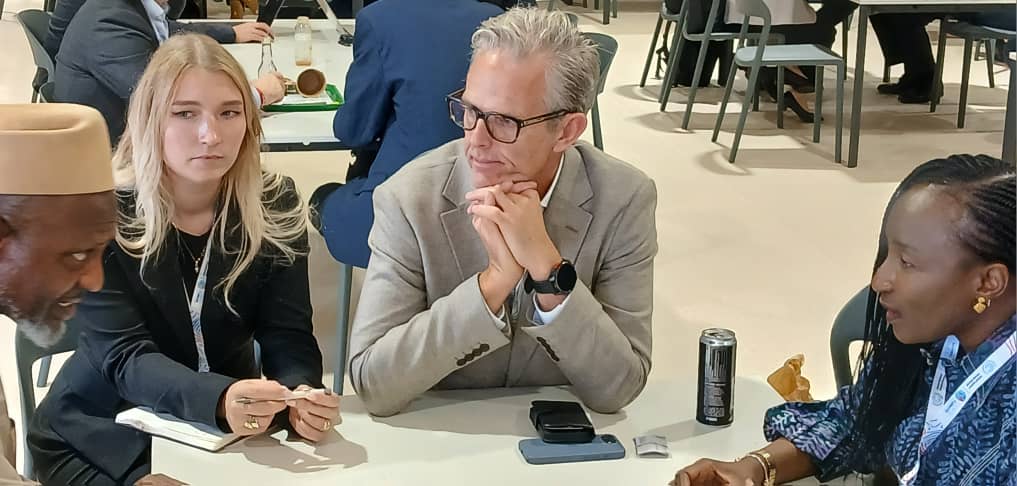
Chief Strategy and Sustainability Officer, NNPC Ltd, Hauwa Mshelia (r), engages ICAF delegates after an MoU on project development for vapour and flare recovery.
• Foreign Affairs Ministry strikes Energy Transition accord with UK
Sopuruchi Onwuka
The Federal Government has reaffirmed its commitment to a significant reduction of emissions in its petroleum industry operations while maintaining that the bilateral agreements signed at the ongoing 31st Conference of Parties (COP31) will not bring the country under pressure to abandon its petroleum resources.
The country’s leading delegates to COP31, which is hosted by the United Nations Framework Convention on Climate Change (UNFCCC) in Antalya, Turkiye, jointly affirmed at the weekend that the country would continue to advance efficient industry practices by cutting methane emissions, commercializing flare gas and collaborating with global partners on abatement and remediation.
The positions formed the summary of numerous debates and presentations that defined Nigeria’s participations at the ongoing World Climate Summit in Europe.
Within the first week of the conference, policy drivers, regulators and technocrats from the Ministry of Foreign Affairs, Nigerian Upstream Petroleum Regulatory Commission (NUPRC) and technocrats from the Nigerian National Petroleum Company (NNPC) Limited reiterated the country’s commitment to a gradual and equitable energy transition that balances Nigeria’s climate obligations with national development priorities.
While the Ministers signed bilateral deals, the NUPRC showcased investment opportunities in Nigeria’s flare gas commercialization programme, and the NNPC demonstrated institutionalization of new emission reporting standards across the full operating loop.
Also, whereas the Minister of State for Foreign Affairs, Sola Enikanolaiye, led bilateral agreements on energy transition; the Managing Director of NNPC Foundation, Mr Chinedu Eze Igwe, showcased Nigeria’s commitment to emission transparency as a credible step towards abatement and control.
Also, the General Manager in charge of Corporate Affairs at NUPRC, Mr Kelechi Ofoegbu, explained how Nigerian regulators are working effectively to stamp out gas flaring through commercial arrangements that offer investors with investment incentives in the Nigerian Flare Gas Commercialization Programme (NFGCP).
All delegates hammered on Nigeria’s determination to continue driving realization oif its economic development objectives while remaining consistent with its climate action initiatives.
Whereas they made presentations at different side events and panel debates, the country’s delegates highlighted efforts to contain methane emissions, eliminate routine gas flaring, improve environmental remediation and diversify the economy towards less carbon-intensive activities.
A major highlight of the country’s strategy is the growing role of NNPC Limited in coordinating the petroleum industry’s response to climate change through emissions measurement, reporting and verification, methane abatement, gas development and the adoption of low-carbon technologies.
Several officials of the national oil company declared a commitment to eliminating routine gas flaring and reducing methane emissions from its operations by 2030, while targeting the adoption of low-carbon technologies, including carbon capture and storage, operational electrification and renewable energy, by 2050.
With these commitments, NNPC representatives have been engaging international energy companies, climate institutions, financiers and industry partners on practical approaches to reducing emissions without undermining energy supply and economic development.
The Federal Government’s diplomatic engagement also produced a non-binding Memorandum of Understanding (MoU) with the United Kingdom on energy security and sustainability, providing a framework for cooperation and support towards implementing Nigeria’s nationally determined contributions (NDCs) to emission reduction.
Ambassador Sola Enikanolaiye, who participated in the agreement, said the understanding would provide opportunities for Nigeria to articulate its energy transition priorities and explore the partnerships, technology and financial support required to meet its climate commitments.
Speaking after the signing ceremony at the COP31 conference arena, he stressed that Nigeria’s energy transition must reflect its development circumstances and should not be dictated by externally imposed timelines or prescriptions.
“Our position is very clear. We need fossil fuel to even fund transition into other alternative sources of energy. So we cannot jump into a transition plan that does not address our national development aspirations and objectives. Which was why we are calling for a just transition plan, an equitable transition plan and a plan that is also sustainable that would not inflict any damage on our own national development aspirations as contained in our NDC 3.0,” he said.
According to the minister, Nigeria’s participation in international climate negotiations is essential to ensuring that its national interests are reflected in global transition policies.
He explained that the non-binding agreement with the UK was designed to strengthen cooperation at different levels, including government-to-government engagements, public-private partnerships, private-sector collaboration and partnerships involving civil society organisations and host communities.
He said the objective was to establish a framework through which Nigeria could mobilise international support for climate resilience, infrastructure development, alternative energy investments and sustainable economic growth.
Enikanolaiye noted that Nigeria was experiencing the consequences of climate change while simultaneously facing pressure to reduce dependence on fossil fuels, which remain a major source of government revenue and foreign exchange earnings.
“We are hoping that this partnership helps us build some level of climate resilience and devise alternative funding for development,” he stated.
He added that the government was already pursuing economic diversification through smart agriculture, innovation, creativity, digital trade and commerce, while financial technology and other service-oriented industries were increasingly contributing to the country’s gross domestic product.
The minister said Nigeria’s transition strategy must also take account of geopolitical developments affecting global energy supply, including the Russia-Ukraine war and tensions involving Iran and the United States in the Middle East.
He maintained that diplomacy would remain important in negotiating international cooperation and ensuring that the country’s energy security and development priorities were protected.
“So, I believe we are on course and we are heading towards zero emissions ultimately. But it has to be gradual. It must take into consideration the different levels of development and national development aspirations,” he explained.
Enikanolaiye dismissed suggestions that the agreement with the UK would expose Nigeria to external pressure over its energy policies, insisting that the partnership was based on sovereign equality and mutual respect for national interests.
“I don’t think we are under any pressure. And even if we do, we have the capacity to remain focused on our national interests. The Nigerian Foreign Ministry and diplomacy have demonstrated that over the years. So, pressure is not a point. We are into partnership of equals of sovereignty,” he said.
He explained that Nigeria expected international partners to support its climate ambitions through technology transfer, financing, infrastructure development and investments in alternative energy sources, while allowing the country to determine the pace and sequence of its transition.
He also cited the government’s promotion of compressed natural gas (CNG), including the deployment of CNG-powered buses, as part of efforts to diversify transportation fuels and ease the cost pressures associated with ongoing economic reforms.
While the diplomatic engagement established the framework for international cooperation, NNPC Limited declared that it has been driving the operational component of Nigeria’s climate commitments within the petroleum industry through its sustainability programmes and engagements with commercial operators.
The company’s Chief Strategy and Sustainability Officer, Hauwa Mshelia, has been leading engagements with operating partners to establish a common industry approach to emissions management, reporting and reduction.
The initiative is aimed at moving climate action beyond individual corporate commitments towards coordinated implementation across the petroleum value chain, with greater emphasis on reliable emissions data, transparency, operational accountability and measurable reductions.
At a session convened by the Oil and Gas Decarbonisation Charter (OGDC) on “Accelerating Global Methane Mitigation in Emerging Economies” at the World Green Economy Organization (WGEO) in the Blue Zone, Managing Director of NNPC Foundation Limited, Chinedu Igwe, presented the national oil company’s progress in strengthening emissions measurement and reporting.
Joining other panellists from Petrobras and PETRONAS, Igwe explained that NNPC Limited had moved its methane reporting capacity from Level 1 to Level 3 under the Oil and Gas Methane Partnership (OGMP 2.0) framework through improved data collection, reporting systems and institutional capacity.
He said the progress demonstrated how credible emissions measurement, reporting and verification (MRV) systems could be established within a relatively short period and extended across industry operations through collaboration with partners.
According to him, the company’s reporting system has become an important instrument for engaging management and operating partners on emissions performance, identifying gaps and tracking progress towards reduction targets.
“Reporting gives us a clear story to tell management and a practical tool for engaging our operators. Our report is on the MiST platform developed by Carbon Limits for independent feedback, and we have carried out leak detection and repair (LDAR) on one of our assets, which is now close to Level 4.
“This allows us to track our carbon footprint from where we were to where we are and where we are headed,” he said.
Igwe maintained that the development of a credible reporting framework was central to building industry-wide awareness and strengthening the commitment of commercial operators to emission reduction.
He said NNPC Limited’s progress was increasingly providing a reference point for industry partners and operators across Africa, demonstrating that effective systems for measuring, reporting and reducing emissions could be developed within the region.
The discussions also highlighted the possibility of reducing methane emissions to near zero while maintaining energy security, sustainability and affordability, particularly in emerging economies that continue to depend on petroleum resources to finance development.
The OGDC, which was established through the Oil and Gas Climate Initiative (OGCI) to promote collaboration among oil and gas companies on emissions reduction, also launched its 2026 status report at COP31.
The report reviews member companies’ interim ambitions, methane and gas-flaring action plans, and progress in emissions measurement and reduction.
NNPC Limited’s contribution highlighted how the company had developed the capacity to measure its carbon footprint through a credible reporting and verification system within 12 to 18 months.
The company joined the OGDC at COP28 in Dubai, United Arab Emirates, as part of efforts to collaborate with international oil and gas companies, share technical expertise and strengthen its emissions management capabilities.
Beyond methane management, NNPC Limited has also been advancing natural gas as a central component of Nigeria’s energy transition strategy.
At a high-level session at the Nigerian Pavilion titled “Decarbonising Africa’s Value Chain: The Role of National Energy Companies, Finance and Strategic Partnerships,” Philemon Yilleng, Manager, Sustainability Strategy, Standards and Policy at NNPC Limited, presented natural gas as the company’s principal mechanism for supporting the transition while reducing the environmental footprint of petroleum operations.
He explained that the company was pursuing investments in gas production and utilisation alongside renewable energy development and operational emission reduction, rather than treating the energy transition as a sequential process that requires abandoning existing energy sources before developing alternatives.
According to him, NNPC Limited is working with regulators, joint venture partners and financiers to integrate sustainability considerations into its operations while expanding gas supply to support industrialisation and energy security.
Managing Director of Carbon Limits, Stephanie Saunier, who participated in the discussion, commended the company’s emissions measurement, reporting and verification framework, noting that credible data was important in providing investors with confidence in the environmental performance of energy projects.
NNPC Limited also participated in the Boston Consulting Group (BCG) Leaders Roundtable on “Delivering Methane Emissions Reduction Across Waste and Energy,” where its Manager, Sustainability Partnerships, Ikechukwu Aturuobi, joined other industry leaders to discuss practical approaches to containing methane emissions in the waste and energy sectors.
On the sidelines of COP31, the company, through Mshelia, also held an exploratory meeting on project financing and development with representatives of the Inclusive Climate Action Fund (ICAF) and ANTAN Producing Limited. Managing Director of NNPC New Energy Limited, Haruna Abdurrahman, participated in the engagement.
The discussions formed part of broader efforts to identify financing opportunities and strategic partnerships that could accelerate the implementation of low-carbon projects within Nigeria’s energy industry.
Under its sustainability theme, “Action Not Words,” NNPC Limited has anchored its net-zero pathway on establishing a verified emissions baseline and developing measurable targets for reducing the environmental impact of its operations.
Its 2030 commitments include eliminating routine gas flaring and reducing methane emissions, while its longer-term 2050 ambitions encompass operational electrification, renewable energy deployment and the adoption of carbon capture and storage technologies.
The company’s approach reflects Nigeria’s broader effort to reconcile its climate obligations with the need to expand domestic energy production, improve access to affordable energy and mobilise resources for economic transformation.
Through its sustainability division, NNPC Limited is seeking to establish a coordinated industry framework in which regulators, commercial oil producers, joint venture partners and other operators adopt common standards for measuring, reporting and reducing emissions.
The emerging strategy places the national oil company at the centre of efforts to translate Nigeria’s international climate commitments into practical operational changes across the petroleum industry, while the bilateral understanding with the UK and other international engagements are expected to provide additional financial, technical and institutional support for the country’s transition objectives.
For a better society
_______________________________
Follow us across our platforms:
Instagram – https://www.instagram.com/championnewsonline/
Facebook – https://web.facebook.com/championnewsonline
LinkedIn – https://www.linkedin.com/company/champion-newspapers-limited/
https://x.com/championnewsng/
You can also like and comment on our YouTube videos.
https://youtu.be/QIBfD1tT80w?si=R4Qf3so2LxYu3GC2