
AKOR SYLVESTER, Abuja
The Minister of state for Health and Social Welfare, Adekunle Iziaq Salako, has raised concern over alarming records of deaths from colorectal cancer, saying the disease kills about 5,900 persons in Nigeria every year.
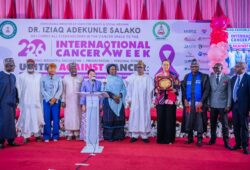
Salako who spoke during the formal launch of the Innovative Cancer Medicines Demonstration Project, a pioneering effort that marks another major stride in Nigeria’s journey toward equitable access to cancer care, in Abuja Tuesday said cancer remains a leading cause of death in Nigeria, with colorectal cancer, the second most common in men and the fourth overall in Nigeria almost tripling in incidence over the past 4 decades.
The minister said that, due to late presentation, limited treatment options, colorectal cancer alone is responsible for nearly 5,900 deaths every year in the country.
According to him: “These statistics are sobering, but they also fuel our resolve under the government of President Bola Ahmed Tinubu to revolutionize cancer prevention, control and overall management in Nigeria”.
The minister stated that the ICM demonstration project, anchored at the National Hospital Abuja, introduced nivolumab, an immunotherapy drug that harnesses the body’s immune system to fight cancer, a treatment already saving lives globally.
For Nigeria, he said, “this is not merely a demonstration study; it is a proof of possibility that innovative cancer care can be delivered safely, sustainably, and locally. Through this project, we will gather critical data on patient experiences, health-system readiness, and the infrastructure investments needed to scale such therapies nationwide. It is an opportunity to shape an African model of sustainable access to innovative medicines”.
He further noted that: “This demonstration aligns squarely with the Federal Government’s broader National Cancer Control Plan and the Renewed Hope Health Agenda, which prioritizes local research, early detection, access to diagnostics, and affordable innovative treatment.
“The Federal Government of Nigeria, under the leadership of President Bola Ahmed Tinubu, is deeply committed to strengthening our oncology ecosystem.
“Through agencies and programmes such as National Institute for Cancer Research and Treatment (NICRAT), National Agency for Food Drugs Admnistration and Control , and the National Cancer Control Programme, we are building regulatory capacity, supporting research ethics digitization, and investing in workforce development ensuring that innovation reaches every patient who needs it.
“We are also advancing partnerships with private and philanthropic sectors to unlock the healthcare value chain, catalyzing both health and economic dividends for Nigerians.
“The Federal Government recognises that oncology care is one of the commonest reason for outbound medical tourism and is determined to reverse this trend within the shortest possible time by investing heavily to provide cancer treatment infrastructure. 6 regional cancer centres of excellence have been constructed with 3 of them already commissioned and the remaining to be commissioned soon”.
The minister noted that, in the 2025 budget, the government has provided unarguably the highest budgetary allocation for cancer infrastructural development in furtherance of the commitment, adding that: “We are not just focusing on treatment, attention is also being paid to prevention by raising awareness on life style modification, scalling up immunization for vaccine-preventable cancers and providing screening services”.
He called on the regulatory authorities and bodies in the health sector charged with facilitating such researches and innovation like this to be diligent but also timely.
“We must work out protocols and mechanisms that does create stumbling blocks to innovations even as we protect public health”, he said.
The minister commended the staff and management of National Hospital, Abuja for its leadership and commitment to excellence, while also thanking partners, CHAI, PICI, BMS, and Roche for demonstrating faith in Nigeria’s institutions and for sharing a vision that innovation must be inclusive.
He said the collaboration, between the Clinton Health Access Initiative (CHAI), the Parker Institute for Cancer Immunotherapy (PICI), Bristol Myers Squibb (BMS), Roche, and the Federal Ministry of Health and Social Welfare exemplified how global solidarity, scientific excellence, and National leadership can converge to transform outcomes.
“To our local oncologists, nurses, researchers, and patient advocates your work forms the backbone of this progress. Without your commitment, today’s milestone would not have been possible.
“As we launch this demonstration project, let us remember that every innovation must ultimately serve the people. Let this partnership be the beginning of a new era where no Nigerian dies unnecessarily because advanced care is out of reach. We must continue to strengthen our data systems, prioritize equity, and ensure that access to innovation is not a privilege but a right. Together, we can make Nigeria and indeed Africa a leader in delivering world-class, patient-centered cancer care”, he noted.
For a better society
Follow us across our platforms:
Instagram – https://www.instagram.com/championnewsonline/
Facebook – https://web.facebook.com/championnewsonline
LinkedIn – https://www.linkedin.com/company/champion-newspapers-limited/
https://x.com/championnewsng/
You can also like and comment on our YouTube videos.
https://youtu.be/QIBfD1tT80w?si=R4Qf3so2LxYu3GC2