…Stakeholders urged to move beyond policy declarations as national summit holds October 29
Favour Ishember, Abuja
Nigeria’s transition to Compressed Natural Gas (CNG) will only enjoy widespread public acceptance when households, workers and businesses begin to experience clear economic benefits from the initiative, National Chairman of the National Compressed Natural Gas Forum (NCNG-F), Faruk Abdullahi, has said.
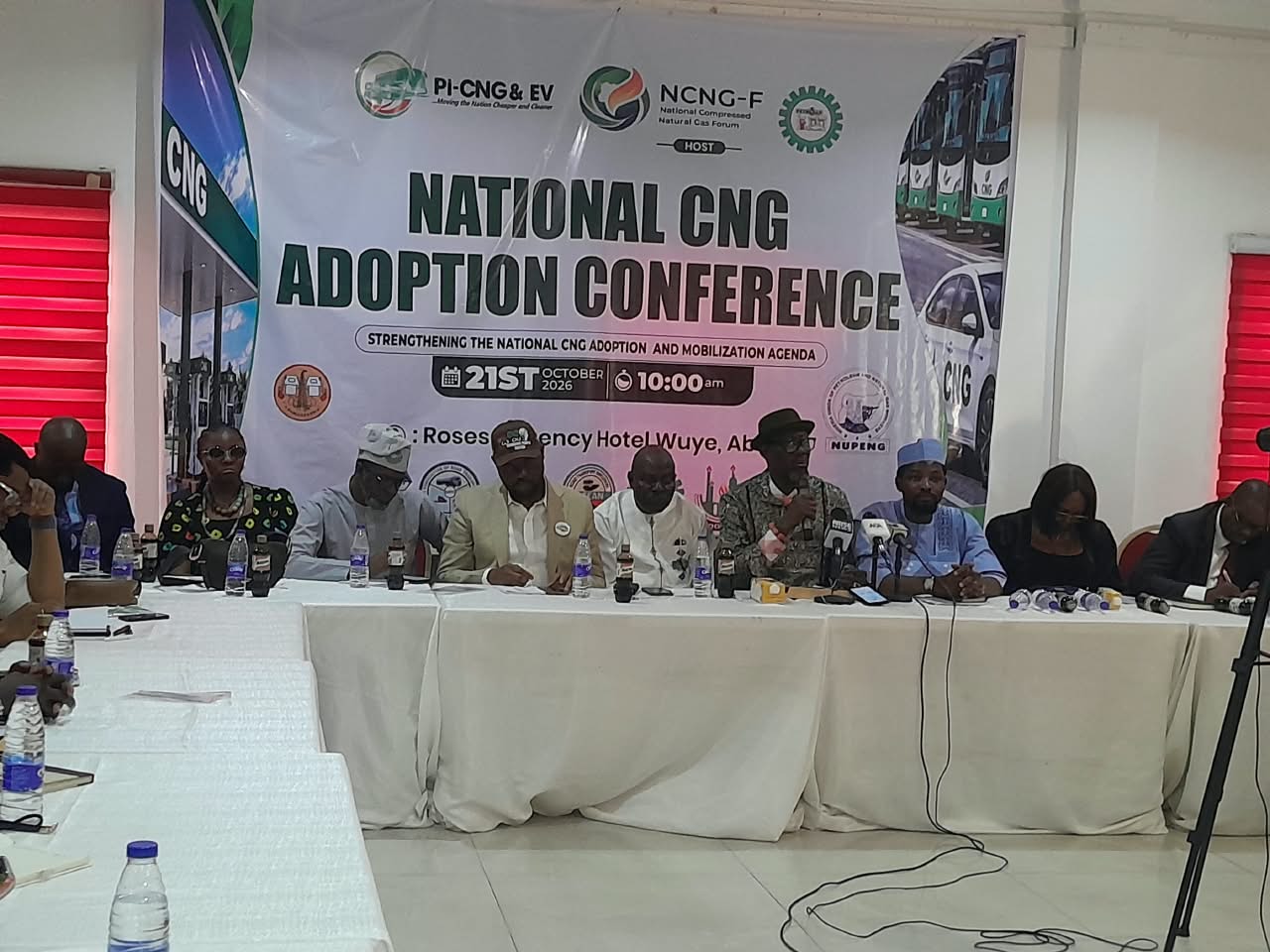
Abdullahi stated this on Wednesday while declaring open the National CNG Adoption Conference and Strategic Stakeholders’ Meeting at Roses Regency Hotel, Wuye, Abuja, insisting that the nation’s shift to cleaner energy must remain a collective national project driven by collaboration across every sector of the economy.
He said the proposed transition to CNG requires practical implementation rather than policy pronouncements, stressing that organisations participating in the initiative must appoint dedicated CNG focal persons, organise awareness campaigns, support pilot conversion programmes and work with financing institutions as well as certified conversion providers to make the switch easier for their members.
According to him, the conference was convened to mobilise unions and organisations to champion CNG adoption, address major challenges including vehicle conversion costs, inadequate refuelling infrastructure, limited financing and poor public awareness, while obtaining firm commitments from participating organisations for coordinated implementation.
Abdullahi urged stakeholders to utilise the proposed National CNG Road Show to build public confidence and demonstrate nationwide backing for the initiative ahead of the Maiden National CNG Summit scheduled for October 29, 2026, where key issues relating to investment, infrastructure expansion and policy coordination would be further discussed.
He also proposed that every participating organisation should nominate a CNG focal person, commence internal awareness campaigns, identify members for pilot vehicle conversion projects and establish measurable adoption targets supported by a coordinated reporting framework.
The NCNG-F chairman noted that Nigeria’s transition to cleaner energy can only succeed through the collective commitment of government institutions, organised labour, transport unions, petroleum and energy associations, private investors, development partners, financial institutions and millions of Nigerians whose livelihoods depend on affordable energy.
He observed that the removal of fuel subsidy had sharply increased transportation and production costs, making it necessary for the country to embrace practical and sustainable alternatives capable of reducing dependence on conventional fuels while improving economic productivity.
According to him, Nigeria’s vast natural gas reserves, expanding transport market and rising demand for affordable energy provide a significant opportunity for CNG to reduce transport costs, improve business competitiveness, create employment opportunities and stimulate investments throughout the gas value chain.
Abdullahi, however, warned that large-scale adoption would only become a reality when vehicle owners have access to affordable, safe, reliable and widely available conversion and refuelling infrastructure, stressing that government policies alone would not convince motorists to embrace CNG.
He called on transport unions to educate their members, identify vehicles suitable for conversion, facilitate access to accredited conversion centres, negotiate group conversion arrangements and partner financial institutions to develop affordable financing packages.
He equally urged organised labour to intensify awareness among workers, while petroleum marketers, gas suppliers, conversion centres and other operators were encouraged to strengthen public confidence through quality service delivery, transparent pricing, strict compliance with safety standards and expansion of infrastructure nationwide.
The NCNG-F chairman further appealed to private sector operators, investors and financial institutions to increase investment in gas supply, refuelling facilities, vehicle conversion, fleet management and related technologies, while introducing financing models capable of reducing the cost burden on businesses, cooperatives and individual vehicle owners.
He also urged government agencies and development partners to reinforce enabling policies, improve access to finance, expand infrastructure and ensure that public enlightenment campaigns translate into visible results across the country.
For a better society
_______________________________
Follow us across our platforms:
Instagram – https://www.instagram.com/championnewsonline/
Facebook – https://web.facebook.com/championnewsonline
LinkedIn – https://www.linkedin.com/company/champion-newspapers-limited/
https://x.com/championnewsng/
You can also like and comment on our YouTube videos.
https://youtu.be/QIBfD1tT80w?si=R4Qf3so2LxYu3GC2