
… varsity develops Abuja aerodrome, secures approval for aerospace, aviation management programmes
Favour Ishember, Abuja
Baze University, Abuja, has disclosed that construction work on its proposed aviation school infrastructure has reached about 50 per cent completion, despite delays caused by the rainy season.
The Chancellor of the university, Senator Datti Baba-Ahmed, said the project was designed to strengthen aviation education in Nigeria by combining academic learning with practical flight training.
He said the institution had continued with construction activities around the clock, adding that the development of the aviation facility remained a major priority for the university.
“We began modestly, but construction is ongoing 24 hours a day, seven days a week. From January to date, we are about 50 per cent through establishing the infrastructure for Baze Aviation School,” Baba-Ahmed said.
The chancellor disclosed that the university was developing an aerodrome in the Federal Capital Territory measuring 1,800 metres in length and 30 metres in width, with an additional 50 metres shoulder.
Baba-Ahmed described the facility as a major national project that would complement Abuja’s growth as Nigeria’s capital city, adding that an additional aerodrome would provide significant benefits to the territory.
He said Baze University was targeting the training of at least 600 aviation professionals, subject to regulatory approvals, across different fields including pilot training, air traffic control, aircraft rescue and firefighting.
The aviation programmes would also support the university’s existing academic offerings in aeronautical engineering and aviation management.
Baba-Ahmed acknowledged the contributions of regulatory and government agencies, including the National Universities Commission (NUC), Nigerian Civil Aviation Authority (NCAA) and Nigerian Airspace Management Agency (NAMA), towards the advancement of the aviation project.
The Vice-Chancellor of Baze University, Prof. Abiodun Adeniyi, described the initiative as a landmark achievement that would strengthen the institution’s position in Nigeria’s and Africa’s higher education landscape.
Adeniyi said the university was working towards becoming the first privately owned university in Africa to operate an aviation school equipped with its own aircraft.
He noted that while the University of South Africa, a public institution, has an aviation training school, Baze University’s project represents a significant milestone for private-sector participation in aviation education.
The vice-chancellor praised Baba-Ahmed’s commitment to expanding access to specialised education through investment in practical training facilities.
Earlier, the Coordinator of the Baze Aviation School Project, retired Air Vice-Marshal Aliyu Bello, described the aircraft acquisition and infrastructure development as key steps towards producing skilled manpower for Nigeria’s aviation sector.
Bello said the aviation school concept was initiated by Baba-Ahmed about four to five years ago with the goal of establishing a centre that would merge classroom education with practical flight experience.
He revealed that the university had secured about 92 hectares of land at Gwari, on the outskirts of Abuja, for the aviation facility.
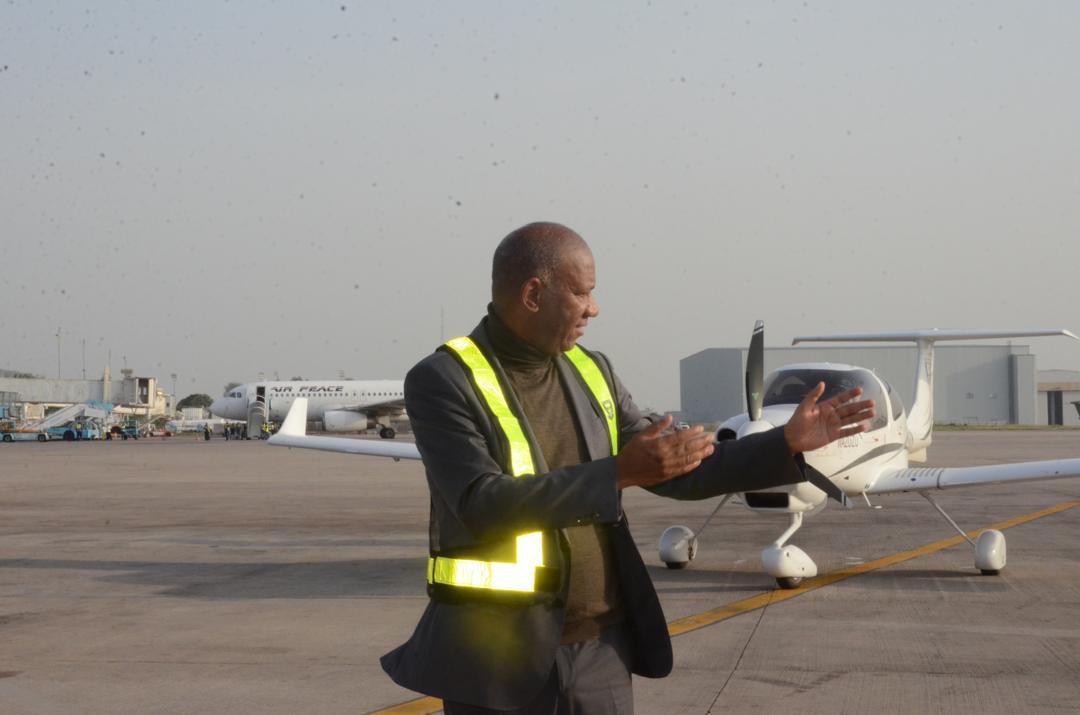
Bello said the two Diamond KMO 40 single-engine training aircraft acquired by the university are brand-new, with only about 40 to 50 flying hours, making them suitable for the institution’s initial pilot training programme.
He, however, explained that additional equipment, including a twin-engine aircraft and a flight simulator, would be needed to support advanced training, instrument ratings and multi-engine operations.
The project coordinator expressed confidence that further investments would be made to provide the necessary facilities required for comprehensive aviation training.
Bello also confirmed that Baze University had received approval from the NUC to run two aviation-related programmes — Aerospace Engineering and Aviation Management.
He said the university’s training model would set it apart from conventional classroom-based aviation education by integrating theoretical knowledge with hands-on flight experience.
Bello added that the arrival of the aircraft demonstrated the university’s preparedness to move the project closer to operational take-off and student enrolment for flight training.
He commended the chancellor’s commitment to aviation education, saying the initiative would help develop the skilled workforce needed to advance Nigeria’s aviation industry.