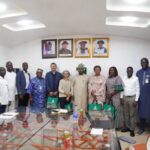

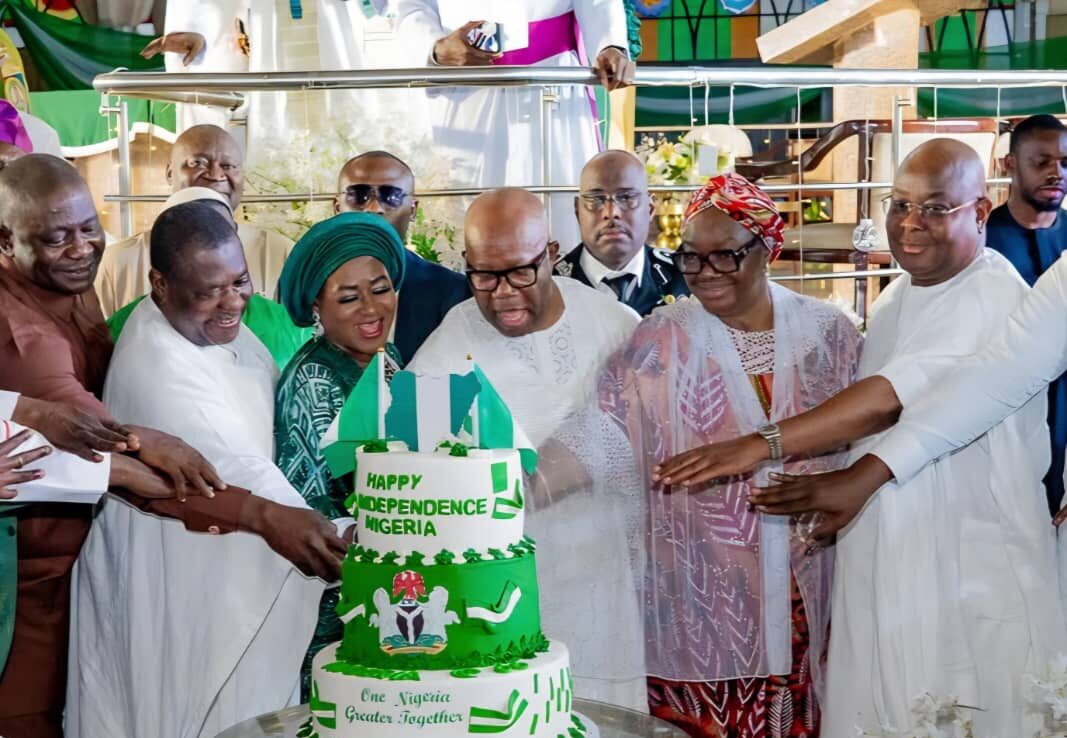
L-r… Minister of Defence, Gen Christopher Musa; Secretary to the Government of the Federation, Senator George Akume; representative of the First Lady and wife of Minister of State Trade and Industry, Mrs Rachael Eno; President of the Senate, Godswill Akpabio; Wife of the Senate President, Mrs Unoma Godswill Akpabio and Senator Osita Izunaso during the Inter- Denominational Church Service to mark the 66th Nigeria’s Independence Celebration at the National Worship Centre, Abuja yesterday. Photo: Senate President’s Office.
- Demand end to hardship, insecurity, underdevelopment
- Stakeholders blame poor leadership for nation’s setbacks
- Challenge govt to end impunity culture, misgovernance
Victor Duruamaku, Chidimma Uchegbu, Paul Adunwoke, Elizabeth Vincent, Daniel Dauda, Joseph Okwuofu, Akaiso Akaiso, Ignatius Okorocha, Michael-Azeez Ogunsiji, Steve Unegbu, Blessing Omale and Akor Sylvester
Barely 72 hours to Nigeria’s 66th Independence anniversary, a broad cross-section of Nigerians has called on the country’s political leaders to end the hardship, insecurity and underdevelopment confronting citizens and redirect the nation towards sustainable progress and prosperity.
From civil society activists and politicians to academics, professionals, traders, religious leaders, retired public servants, health experts and ordinary citizens, the message emerging from interviews conducted by Daily Champion correspondents across the country was largely one of disappointment over the gap between Nigeria’s enormous human and natural resources and the quality of life available to its citizens.
Many of the respondents said the country had departed significantly from the aspirations of its founding fathers, including Nnamdi Azikiwe, Obafemi Awolowo and Ahmadu Bello, although some also pointed to gains recorded in democracy, telecommunications, education, entrepreneurship, technology and other sectors since independence.
Our respondents stated that the anniversary presents an opportunity not only to celebrate Nigeria’s survival as a united country but also to demand a more purposeful leadership capable of translating the country’s resources and potential into security, jobs, affordable healthcare, quality education, infrastructure and improved living standards.
Pioneer Chairman of the All Progressives Grand Alliance (APGA) and National Chairman of Igbo Agenda Dialogue, Chief Chekwas Okorie, offered a critical assessment, arguing that while Nigeria had recorded 26 years of unbroken democratic practice, it had experienced what he described as 66 years of retrogressive governance.
“My candid assessment of Nigeria at 66 is a very chequered one,” Okorie said, recalling the civil war, military interventions and the country’s transition from a parliamentary to a presidential system of government.
He acknowledged the significance of 26 years of uninterrupted democracy but said the record on development, welfare and security remained troubling.
He noted that the Nigerian Constitution identifies the welfare and security of citizens as the primary purpose of government, arguing that successive governments had failed to adequately fulfil that mandate.
“Our story has been that of degenerating retrogression instead of progress. We are not making progress; rather, we are retrogressing. Every year we find that the year before was better, and that has been the sad story of Nigeria,” he said.
Okorie said countries that Nigeria was ahead of at independence, both in Africa and Asia, have since moved far ahead. He attributed the situation to poor leadership.
He also expressed concern over national disunity, saying the lack of common purpose had weakened the capacity of governments to implement development policies. He said many young Igbo Nigerians had become alienated from the country and recalled that his Igbo Agenda Dialogue had been working to restore confidence in Nigeria among citizens.
On the political outlook, Okorie described the 2027 election as a referendum through which Nigerians could express their views about the direction of the country, while pointing to the recent Osun State election as an indication that citizens could make political statements without resorting to violence.
In Ogun State, public analyst Dr. Gbenga Adeoye offered a measured assessment, saying Nigeria had made progress but at a pace considerably slower than the vision of its early nationalist leaders.
He pointed to the country’s human capital achievements, noting that Nigeria had produced more than 130,000 medical doctors, many of whom now contribute to healthcare systems around the world, alongside more than 210,000 lawyers and over 64,000 chartered accountants.
Adeoye, however, called for urgent attention to agriculture, stronger mortgage and hire-purchase systems to enable citizens to acquire houses, vehicles and other essential goods.
He also called for an aggressive campaign against corruption, particularly the inflation of government contracts.
He advocated increased electricity generation, better roads, properly equipped schools and hospitals, as well as an integrated railway network linking major Nigerian cities.
National Vice Chairman, Southwest, of the Labour Party, Comrade Abayomi Arabambi, described the anniversary as both a celebration and an opportunity for sober reflection.
He recalled that October 1, 1960, marked Nigeria’s emergence as a sovereign nation and noted that the economy of the First Republic was largely driven by agriculture, with groundnuts, cocoa and palm oil serving as major sources of revenue.
According to Arabambi, strong regional governments and agricultural production gave the First Republic considerable promise before political instability and ethnic rivalry interrupted the process.
Decades of military rule subsequently affected institutional development, although that period also witnessed major projects and initiatives including the development of Abuja and the National Youth Service Corps scheme.
He described the return to democratic rule in 1999 as another significant milestone, noting that Nigeria had since experienced its longest uninterrupted period of civilian rule.
Arabambi also cited telecommunications, Nollywood, Afrobeats, technology, sports and entrepreneurship as areas where Nigerians had achieved international recognition, alongside advances in population growth, education, cultural influence, democratic continuity and infrastructure.
But he said the country had fallen short of the aspirations of its founding fathers in national cohesion, economic self-reliance, federalism, governance, public accountability and security.
He expressed concern over Nigeria’s dependence on crude oil and food imports, inflation, unemployment and the concentration of political and economic power at the centre, which he said had left many states dependent on federal allocations.
Citing Section 14(2)(b) of the 1999 Constitution, Arabambi stressed that “the security and welfare of the people shall be the primary purpose of government.”
He argued that laws and policies could only produce results when backed by adequate budgetary provisions and proper utilisation of public resources. He called for a development process that moved from citizens’ demands and policy proposals to legislation or policy formulation, public debate, budgetary allocation and implementation.
For him, Nigeria’s next phase should focus on nation-building beyond oil, with greater investment in human capital, education, electricity, inclusive governance and a stronger federal structure.
‘We deserve better’
For many older Nigerians, the disappointment was rooted in memories of a country they said once offered greater opportunities and basic services despite having fewer resources.
Octogenarian statesman Chief Jude Udensi decried what he described as the situation Nigerians had been subjected to by politicians and poor leaders.
Recalling the early years after independence, Udensi said the economy was then strong and workers, public servants and civil servants were properly remunerated and paid their salaries as and when due.
“Our leaders at that time were sincere unlike the present day leaders who has no reference to God in taking their decisions and making policies which affect the people directly,” he said.
Retired civil engineer Engr. Joseph Odionyemma was even more critical, arguing that Nigeria had achieved little commensurate with its 66 years of nationhood.
He called for a change in the system of government that would reduce the concentration of power in the hands of political office holders. He also alleged that political leaders were more concerned with personal interests than citizens’ welfare.
Odionyemma cited the removal of oil subsidy and alleged that governors had used proceeds meant for other purposes. He challenged Nigerians to hold governors accountable, particularly as another electoral period approached.
Mr Isidore Anoka, in an opinion titled “Betrayal of Our Modern-Day Nigerian Intelligentsia,” criticised sections of the intellectual community, arguing that some Nigerian intellectuals in government and public institutions had abandoned their responsibility to speak truth to power and expose falsehood.
He contrasted Nigeria’s intellectual and natural-resource endowment with persistent poverty, corruption, illiteracy, ignorance, tribalism, religious tensions and insecurity.
Mr George Boston similarly attributed Nigeria’s setbacks to poor leadership, corruption, insecurity, weak institutions and poor policy implementation.
He called for greater emphasis on security, job creation, quality healthcare and education, infrastructure and citizens’ welfare, alongside accountable leadership and effective implementation of policies.
“Nigeria has the potential to do better, what is needed is the commitment and political will to make it happen,” Boston said.
Pastor Prevail Mamodu framed the problem around the meaning and practice of democracy. He said the founding fathers and nationalists who fought for independence envisioned a country capable of catering for its citizens, providing infrastructure and becoming a global icon.
In his view, that objective had not been fully achieved.
Mamodu argued that democracy itself was not the problem but that its practice in Nigeria had deviated from the principle of government of, by and for the people.
He said many Nigerians were not enjoying the dividends of democracy, with the benefits of government appearing concentrated among a small section of the population while the majority continued to struggle.
“Nigerians are suffering and passing through a lot of pain,” he said, adding that more than three years of reforms had brought increased hardship and pain for many citizens, even as the government continued to promise transformation and better times.
His recollection of basic amenities in rural communities underlined his disappointment. Growing up during the military era, he said, he remembered having access to pipe-borne water even in his village and other remote parts of the country.
“But go back to my village today, and many of those pipe-borne water systems are no longer there. Those basic amenities have disappeared,” he said.
Resource wealth, but persistent deprivation
The contrast between Nigeria’s enormous resources and citizens’ living conditions emerged repeatedly in the responses.
Former Bayelsa State House of Assembly member, Hon. Chief Augustus Osomu, said Nigeria’s enormous human, mineral and material resources had not been adequately harnessed to deliver the level of development expected after six decades of independence.
He linked the development challenge to the quality of democracy, particularly the ability of citizens to freely exercise their franchise and determine who represents them.
Osomu urged political parties and politicians to respect voters’ choices and allow credible candidates to emerge through processes reflecting the will of the people.
“The electorate should be allowed to make their own choices, political parties should not be focused solely on winning elections, Nigerians should be allowed to choose credible candidates who can genuinely represent their interests,” he said.
He warned that failure to respect voters’ choices could weaken public confidence in democratic institutions and the electoral process, while also expressing concern about ethnic favouritism in political appointments.
Executive Director of the Civil Liberties Organization (CLO), Comrade Steve Aluko, urged policymakers to adhere strictly to the 1999 Constitution, as amended, as a means of addressing what he described as misgovernance.
Aluko said Nigeria had moved from “the good, the bad, to a very ugly precedence”, arguing that the country had failed to adequately protect lives and provide basic amenities for a large section of its population.
He identified lack of checks and balances, insufficient autonomy for states and local governments and what he described as an overbearing federal structure as obstacles to development.
For Aluko, the solution required adherence to the constitutional principles of fairness, equity and justice, as well as leadership based on competence, character, proficiency and solutions.
“We must be able to cut short the culture of impunity because nobody in this country should be licensed to kill, to maim and destroy,” he said.
The Awolowo benchmark
In Ibadan, the question posed by respondents was whether Nigeria had fared better than the country envisioned by its founding fathers.
Chief Wole Akinwande, a 78-year-old elder statesman and member of the Central Council of Ibadan Indigenes (CCII), who witnessed the First Republic, said the founding fathers envisaged a federation built around productivity and welfare.
He cited the policies of the Western Region under Chief Obafemi Awolowo between 1954 and 1959, including free primary education, free healthcare for children, farm settlements at Ijaye and Iresa and Africa’s first television station, as examples of the development model he believed the founders envisioned.
“What we have now is a Nigeria where government budgets for convoys before classrooms,” Akinwande said.
University of Ibadan political scientist Prof. Remi Aiyede similarly traced Nigeria’s difficulties to poor leadership and policies.
He argued that Nigeria remained far from the founding fathers’ vision and called for greater devolution of economic responsibilities.
“Let Oyo State control its solid minerals in Igbeti and Kajola, its agriculture, and pay tax to centre,” Aiyede said, referring to the 1963 Constitution’s 50 per cent derivation principle. He contrasted that with the present debate over 13 per cent derivation.
According to him, Nigeria’s development trajectory was altered at three major points: the January 1966 coup, which he said truncated federalism; the oil boom of 1973, which shifted emphasis from production to distribution; and the prolonged military period, which he said weakened institutions.
Aiyede argued that the founding fathers believed in strong regions and a weaker centre, whereas the current system had produced a powerful centre alongside 36 states that depend heavily on federal allocations.
At the grassroots level, Alhaja Basirat Oladimeji, Iyaloja of Bodija International Market, Ibadan, described the country’s journey as a failure to get the basics right.
“We market women are the barometer,” she said, comparing purchasing power in 1980 with current conditions. She recalled Nigeria’s former agricultural and industrial production, including cocoa in Oke-Ogun and textiles in Iseyin, and criticised the country’s current dependence on imports.
Oladimeji advocated single-digit loans for traders and mechanised farming as part of the way forward.
Citizens divided between resilience and disappointment
The anniversary also produced divergent assessments, with some politicians and public figures emphasising Nigeria’s resilience and achievements rather than its shortcomings.
Former member of the Akwa Ibom State House of Assembly, Hon. Aniekan Etim, said Nigeria had reasons to celebrate, citing the country’s continued unity despite the civil war, military coups and economic challenges.
He described uninterrupted civilian rule as an achievement and urged Nigerians to support President Bola Tinubu’s reforms, including fuel subsidy removal and exchange-rate unification, which he said were painful but necessary for long-term growth.
Chairman of the Civil Society Forum in Akwa Ibom State, Mr Clifford Thomas, disagreed, saying there was little to celebrate when citizens could not feed or move safely.
He cited insecurity, kidnapping, hunger, the high price of rice, a weak naira and the migration of young Nigerians as evidence of the hardship confronting citizens.
Thomas called on the Federal Government to tackle insecurity decisively, create jobs and reduce the cost of governance to free resources for development.
NLC State Chairperson Comrade Sunny James said workers were among those worst affected.
He contrasted the conditions of the civil servant of 1960, who he said lived in government quarters, sent children to good schools and retired with dignity, with those of contemporary workers struggling to pay rent and feed their families.
James called for implementation of a living wage and prompt payment of arrears.
A retired federal Permanent Secretary, Mrs. Grace Udoh, blamed the political class for abandoning the founding fathers’ vision of a productive federation.
“They dreamt of a productive federation. We turned it to a consuming nation dependent on oil and imports. We must return to true federalism and revive agriculture and industries,” she said.
PDP Publicity Secretary in the state, Barr. Ewah Okpo, similarly attributed Nigeria’s problems to leadership rather than lack of resources.
“Our problem has never been resources, it is management,” he said, calling for electoral integrity, votes that count and accountability for corruption.
Youth exodus, healthcare crisis deepen concerns
In Abia State, Igbo leader and Chief Executive Officer of Sinwez Company, Nze Ezeji, said Nigeria was not doing well at 66, citing the increasing number of young Nigerians leaving the country because of hardship.
He linked the situation to poor leadership and the cost of petroleum products, and urged Nigerians approaching the general election to put aside sentiments, tribalism, statism and egocentrism when choosing political leaders.
Professor Olorunshola Omodamiro, a university don and pastor, offered a more nuanced assessment, describing Nigeria’s journey since 1960 as a mixture of achievements, setbacks and opportunities yet to be fully realised.
He said Nigeria had undergone enormous expansion in education, healthcare, telecommunications, banking, science and technology, infrastructure, entrepreneurship and professional development.
“I will not describe Nigeria’s journey as a failure. But I would also say that we have not yet achieved the Nigeria that our founding fathers dreamed of,” Omodamiro said.
Executive Secretary of the Abia State Primary Health Care Development Agency, Dr. Kalu Ulu Kalu, said the founding fathers started well, but successive political transitions between civilian and military rule disrupted development.
He cited the neglect of primary healthcare, recalling the position of the late Professor Olukoye Ransome-Kuti that universal health coverage could not be achieved without effective primary healthcare.
Kalu said primary healthcare had been neglected nationally and in Abia State for years, although he pointed to recent efforts to rebuild the sector.
The health sector also emerged as a major indicator of the country’s development gap.
A medical expert identified severe human-resource shortages, brain drain and inadequate funding as longstanding challenges. While Nigeria has recorded gains including longer life expectancy, expanding health institutions and specialist care, the expert said chronic underfunding, workforce losses, poor coverage and stark inequalities persisted, with many Nigerians still seeking medical treatment abroad.
Dermatologist with Botox-Lagos Aesthetics and Wellness Clinic, Dr. Ngozi Felicia Ibe, highlighted Nigeria’s continuing maternal and newborn mortality crisis and weak universal health coverage, noting that estimated enrolment under the National Health Insurance Authority stood at only about five per cent.
She said reducing medical tourism would require rebuilding trust and strengthening local specialist capacity, with subsidised and fast-track funding for high-demand specialties such as cardiac surgery, oncology, orthopaedics and fertility services in selected public and private tertiary centres.
A country still searching for its dream
The Centre for Social Justice and National Integration (CSJANI) said Nigeria was still searching for its dream, arguing that the founding fathers did not envisage a perfect country but a purposeful one.
Director-General Dr. Ojoachele Felix Akor described the Nigeria of the early years as one of competing visions, regional productivity and intellectual contestation, recalling the groundnut pyramids of the North, cocoa wealth of the West and palm-oil prosperity of the East.
He also recalled an era of free education, farm settlements and functional institutions, saying the founding fathers envisioned a federation of productive peoples united in diversity and anchored on justice, merit and collective prosperity.
“What we have today is, in considerable measure, a tragic betrayal of that dream,” Akor said.
He argued that correcting Nigeria’s trajectory would require more than committees, cosmetic reforms or the renaming of ministries, calling instead for fundamental and courageous reforms centred on the public good.
The Nigeria Labour Congress, through its Head of Information and Public Affairs, Comrade Benson Upah, said the country’s journey had been marked by “pits and peaks and occasional laterals”.
“All weighted, we deserve better than we have gotten, for a nation cannot be better blessed than Nigeria, material and human!” Upah said.
He nevertheless expressed hope that the current difficulties did not represent Nigeria’s final chapter, saying Nigerians could still look forward to a new dawn.
Former Deputy Governor of Kogi State and chieftain of the African Democratic Congress, Elder Simon Achuba, attributed Nigeria’s slow progress to corruption, saying it had pushed the country to the “back seat of the vehicle of progress”.
He nevertheless commended the country’s continued togetherness and coexistence since independence, arguing that Nigeria could make progress with good leadership.
Albert Kennedy similarly identified Nigeria’s ability to avoid some of the major disruptions that affected democracy in neighbouring countries as an achievement, but said government needed to do more to understand and respond to the needs of ordinary Nigerians.
For Grace Bentus, a person living with disability, economic difficulties had continued to weigh heavily on vulnerable groups, requiring stronger government support.
She described Nigeria’s continued existence as a major milestone but said the country must translate its potential into improved economic and social conditions.
Real estate agent Agatha Iyomere also said Nigeria still had considerable work to do and urged both citizens and government to look inward.
Government: ‘Nigeria is on the right path’
Against the widespread concerns, President Bola Tinubu urged Nigerians not to lose hope, assuring them that the country was on the path towards recovery, peace and sustainable development.
The President conveyed the message through the Speaker of the House of Representatives, Rt. Hon. Abbas Tajudeen, who represented him at a special prayer session to commemorate Nigeria’s 66th Independence Anniversary at the National Mosque, Abuja.
Speaking with journalists after the prayers, Tajudeen acknowledged the challenges Nigeria had faced since independence but also pointed to achievements recorded over the years.
He said 66 years of nationhood should be viewed as a period of growth and maturity despite the setbacks and missed opportunities.
“Any person of 66 years cannot be called a child anymore. Nigeria has become mature,” Tajudeen said.
He said the President’s message was one of hope and urged Nigerians to remain committed to the country’s progress, arguing that its challenges could be overcome through sustained efforts and collective commitment.
“I want to categorically make it clear that Nigeria is on the right path. There is light at the end of the tunnel. Nigeria has finished making sacrifices for this country to be great again,” he said.
Yet, beneath the competing assessments of Nigeria’s 66-year journey runs a common thread: the country’s vast human, mineral and material endowments have created expectations that many citizens believe remain unmet.
For the respondents who expressed disappointment, the anniversary is therefore more than a commemoration of independence. It is a demand for political leadership capable of converting Nigeria’s resource wealth into productive industries, secure communities, decent jobs, functional public institutions, affordable healthcare, quality education, reliable infrastructure and greater economic opportunity.
For others, the country’s survival, democratic continuity and achievements across several sectors provide a foundation on which to build.
But even among the more optimistic voices, the expectation is that Nigeria’s next chapter must deliver tangible improvements in citizens’ lives. The central challenge, as reflected in the responses, is no longer simply whether Nigeria possesses the resources and talent to prosper, but whether its political and institutional leadership can consistently convert those assets into sustainable progress and shared prosperity.
For a better society
_______________________________
Follow us across our platforms:
Instagram – https://www.instagram.com/championnewsonline/
Facebook – https://web.facebook.com/championnewsonline
LinkedIn – https://www.linkedin.com/company/champion-newspapers-limited/
https://x.com/championnewsng/
You can also like and comment on our YouTube videos.
https://youtu.be/QIBfD1tT80w?si=R4Qf3so2LxYu3GC2