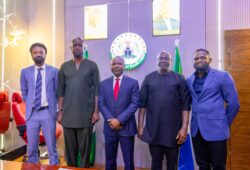

Mr Dapo Adesina, the President, Electric Mobility Promoters Association of Nigeria (EMPAN).
The President of EMPAN, Mr Dapo Adesina, made this known at the ongoing Electric Vehicle (EV) training for roadside mechanics in Lagos.
Adesina said that the training, which would run for six days, involved two cohorts, of which each cohort would be trained for three days, and the graduation ceremony would hold on Saturday.
He said that the training included both practical and theoretical elements of dealing with the repair and maintenance of electric tricycles and motorcycles.
“One of the challenges of adopting the use of electric vehicles in Nigeria is capacity building, to have the capacity for the technical people to handle it, and that is why one of our major objectives at EMPAN is to fill in the gap, to be able to provide support in terms of training.
We are training about 60 roadside mechanics in two and three-wheeler vehicles, that is, the Keke and the Okadas, who will be competent enough to handle the repairs and maintenance of those electric vehicles.
“So that is capacity, we need to build it, and that is what we are doing in this ecosystem,” the president said.
According to him, electric vehicle/mobility is eco-friendly because it eliminates tailpipe emissions, reducing harmful pollutants like CO2 and CO, which are released into the atmosphere.
He said that another benefit was the reduction of noise pollution, since electric vehicles were generally quieter than conventional vehicles.
Adesina, however, said that the challenges for the adoption of electric vehicles included the high cost of acquisition, charging infrastructure, high import duties, myths and misconceptions about electric vehicles, among other reasons.
He also said that Nigeria’s weak grid system and low power generation further complicated the adoption of electric mobility.
The president suggested innovative solutions like having personal power plants and solar systems to address the charging infrastructure challenge.
Also speaking, Mr Sebastian Gruss, the Project Manager, Social Entrepreneurship at Siemens Stiftung, emphasised the importance of collaboration to support the transition to electric mobility.
Gruss said that Siemens Foundation would continue to support local entrepreneurs and solutions, toward boosting Nigeria’s economy.
Mr Gad Ashiagbor, the Executive Director at Africanev, who is one of the trainer, said that electric vehicle make up just one per cent of vehicles in Nigeria.
Ashiagbor said that there was a need for government policy to increase the use of electric vehicles in the country.
For a better society
Follow us across our platforms:
Instagram – https://www.instagram.com/championnewsonline/
Facebook – https://web.facebook.com/championnewsonline
LinkedIn – https://www.linkedin.com/company/champion-newspapers-limited/
https://x.com/championnewsng/
You can also like and comment on our YouTube videos.
https://youtu.be/QIBfD1tT80w?si=R4Qf3so2LxYu3GC2