.As govt says review of senior secondary schools curriculum nearing completion
The Academic Staff Union of Universities has asked Nigerians to hold the Federal Government responsible for the paralysis that will be experienced in Nigerian universities in few days to come.
ASUU Benin Zone gave the charge on Monday at a news conference held at Dennis Osadebay University, Asaba, the Delta State capital.
Speaking on behalf of various ASUU Chairmen of the universities under the Benin zone, the Zonal Coordinator, Monday Igbafen, lamented that scholars are the most marginalised in Nigeria.
Igbafen said, “We want to tell Nigerians not to hold ASSU responsible, but hold the Federal government responsible for the paralysis that will be done to Nigerian universities in few days to come.
“On behalf of the Benin Zone of the Academic Staff Union of Universities, I wish to welcome you to this conference.
“The Benin zone of ASUU comprises University of Benin, Benin City, Ambrose Alli University, Ekpoma, Adekunle Ajasin University, Akungba Akoko, Olusegun Agagu University of Science and Technology, Okitipupa, Delta State University, Abraka, Federal University of Petroleum Resources, Effurun, University of Delta, Agbor, Dennis Osadebay University, Asaba and Southern Delta University, Ozoro.
“We are compelled to call you again at this defining moment in the history of university education in Nigeria, as it has become crystal clear that the Federal Government and its agents are inexplicably determined to cripple academic activities in the nation’s universities once more.
“Since the suspension of our last strike action in October 2022, the Federal Government is yet to make good its promise to actualise the review of our dismal conditions of service. It is yet to sign the draft renegotiated 2009 FGN/ASUU Agreement, which our Union views as a significant milestone in the resolution of the issues at hand.”
He added, “The satisfactory and conclusive renegotiation of the Agreement and its successful implementation is the only desirable solution to the worsening living and working conditions of staff, the pandemic problem of underfunding and other challenges of university governance in Nigeria.
“At the moment, the Federal Government is still unwilling to pay up years of arrears of promotion entitlements, still pays lip service to the duty of adequately funding education and continues to be reluctant to release our withheld three and a half months’ salaries and third-party deductions.
“It is unimaginable that, in the face of the daily exponential increases in the cost of basic services and goods in Nigeria, university lecturers have been abandoned to grapple with the harsh realities of an abysmally poor salary structure they have had to endure for 16 agonising years. Nigerians should be aware that this is a critical moment in the history of university education in the country, as it is currently on the precipice.
“It is on this basis that we call on all well-meaning Nigerians students, parents, civil society organisations, the press, the Nigerian Labour Congress (NLC), statesmen, captains of industry and other stakeholders to prevail on the Federal and various State Governments in our country to honour their agreements with ASUU and prevent the nation’s educational sector from sliding further into an undesirable level of decay and dysfunction.”
ASUU noted that members were not delighted in going on strike but have completely exhausted their options, blaming top government officials for the poor educational system, as their children are outside the country for studying.
.As govt says review of senior secondary schools curriculum nearing completion
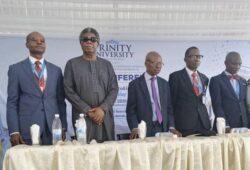
In another development, The Federal Government on Monday said the review of the curriculum for senior secondary schools is nearing completion.
The Minister of Education, Dr. Tunji Alausa, made this known during the 2025 International Conference of the African Curriculum Association hosted by the Nigerian Education Research and Development Council in Abuja.
Recall that the Federal Ministry of Education on Sunday announced the unveiling of the curriculum for basic and technical education.
The implementation of the new curriculum described as “future ready” curriculum is expected to kick off soon.
Alausa, who was represented at the event by the Minister of State for Education, Prof. Suwaiba Ahmad, said the new curriculum was streamlined to meet the skills demand of the 21st century.
“The review and streamlining of the Basic Education Curriculum for Primary 1 – 6 and JSS 1-3 had been completed and approved while that of the Senior Secondary School is nearing completion soonest.
“The review of these curricula is based on best practices and design approach following the requisite stages, criteria and involving broad-spectrum of critical stakeholders. The framework, structure and content of the curricula are based on competency and outcome approach and leveraged on the thematic, spiral-cyclical model. It contains effective pedagogies, resources, and guideline on the use and acquisition of 21st century skills.
“The content of the curricula covers new areas pertaining to digital literacy, robotics and artificial intelligent, new technologies and subject based skills, 21st century skills that are transferrable and issues of values, national heritage and effective citizenship. The newly designed curricula are learner centred implementable and devoid of content overload. One thing we want to achieve in the curriculum reform process is to ensure content learnability and coverage thereby improving learning outcomes across all subjects.
“Thus, the curricula and subjects offerings have been scaled down drastically to align with global standards and endanger effective learning at the various level of primary and senior secondary education.
“The newly revised curricula are to be introduce soonest into the school system for effective implementation,” he said.
Also speaking at the event, the Executive Secretary of the NERDC, Prof. Salisu Shehu, in his paper presentation tagged, “approaching curriculum development from the perspective of a changing social system and learning interest,” stressed the need for curriculum development to be structured after emerging needs.
He said, “As previously noted, we now live in a changing social system influenced by the rise of digital economies, increasing cultural pluralism, demands for inclusivity and learners who seek flexible, personalised education that is connected to real-world experiences and, somewhat beyond the now as they desire to embrace the future at a faster pace.
“Curriculum development, in this case, would best be viewed as an adaptive process that balances the broad demands of our society with the learning interests of learners. But beyond this, there is the challenge of prospective curriculum which seeks to create a learning experience that transcend the now to peep broadly into the future.
“These learning interests comprise both intrinsic and extrinsic motivations that inspire learners to engage with educational content (Renninger & Hidi, 2016), and are shaped by age, socio-cultural backgrounds and the level of desire for skills that enhance employability. Recognising and integrating these learning interests into curriculum design is vital for creating meaningful learning experiences.
“It is in this regard that the Nigerian Educational Research and Development Council has sustained efforts to ensure that our curriculum development process reflects the perspectives of a changing social system and the varied learning interests of learners by adopting an inclusive, learner-centred, competency/outcome-based curriculum framework.
“For instance, we recently revised the 9-Year Basic Education Curriculum to incorporate 21st-century skills and align with societal needs for employability and global citizenship,” he added.
For a better society
Follow us across our platforms:
Instagram – https://www.instagram.com/championnewsonline/
Facebook – https://web.facebook.com/championnewsonline
LinkedIn – https://www.linkedin.com/company/champion-newspapers-limited/
https://x.com/championnewsng/
You can also like and comment on our YouTube videos.
https://youtu.be/QIBfD1tT80w?si=R4Qf3so2LxYu3GC2