Ignatius Okorocha, Abuja with Agency report 
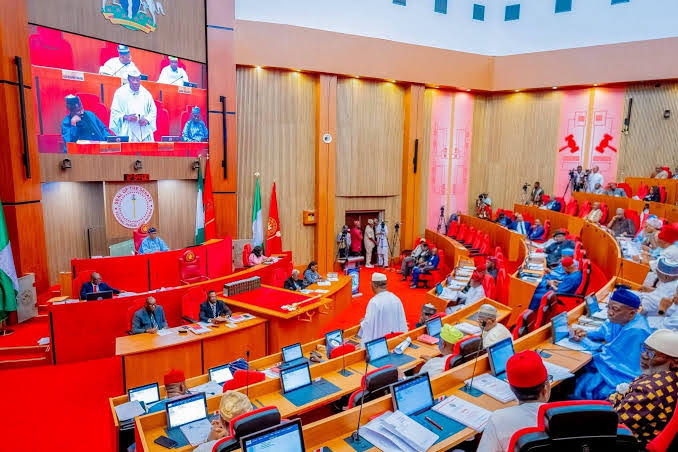
The Senate has raised serious concerns over the growing practice of suspending commercial aircraft landings and restricting airport operations to accommodate movements of Very Important Personalities (VIPs), warning that the practice could trigger an avoidable aviation disaster if urgent measures are not taken.
This is coming as the Nigeria’s Air Traffic Cntrollers have threatened to withdraw their services over the persistent deterioration of the country’s communication and surveillance infrastructure, warning that continued reliance on inadequate equipment is putting pressure on aviation safety and testing the patience of professionals responsible for keeping the nation’s airspace safe.
The upper chamber expressed concern that commercial aircraft, some of which have already taken off and are approaching their destinations, are sometimes forced to remain airborne for extended periods because of VIP movements and security-related restrictions.
Lawmakers warned that keeping passenger aircraft in holding patterns for up to an hour or longer could expose passengers and crew members to unnecessary risks, including fuel depletion, adverse weather conditions, air traffic congestion and other operational emergencies.
The concerns formed the basis of an urgent motion moved by Senator Jibrin Isa, Kogi East which subsequently called for improved coordination among aviation regulatory agencies and security authorities to prevent commercial aircraft from being exposed to avoidable risks.
The Senate acknowledged the importance of security arrangements for the President and other designated public officials but insisted that such privileges must not be exercised at the expense of passenger safety.
As part of its resolutions, the Senate urged the Nigerian Civil Aviation Authority (NCAA), Nigerian Airspace Management Agency (NAMA) and Federal Airports Authority of Nigeria (FAAN) to ensure proper advance coordination and notification of planned airspace restrictions to airline operators.
It further directed that where such restrictions are unavoidable, aircraft yet to depart should be held on the ground, while departure schedules and flight sequencing should be adjusted accordingly, rather than allowing aircraft to take off only to be kept circling in the air.
The Senate also mandated its Committee on Aviation to engage the relevant aviation authorities to ensure strict compliance and report back to the chamber within two weeks.
Contributing to the debate, Senator Dike Plang, representing Plateau Central, drew from his professional experience in the aviation industry to explain the dangers associated with poor flight scheduling and airspace management.
Plang disclosed that he worked with Kabo Air in 1996 as a station manager in Kano and Saudi Arabia, where he received training in ground operations.
He explained that aviation operations depend heavily on accurate timing and coordination, stressing that airlines and airport authorities should be adequately informed about planned VIP movements before commercial flights are cleared for departure.
According to him, it amounts to poor operational management to allow an aircraft to take off for a particular destination when authorities already know that another movement will prevent it from landing at the scheduled time.
He maintained that flight departures and arrivals must be properly coordinated to avoid unnecessary delays and potential emergencies.
The senator also noted that although aircraft are required to carry sufficient fuel to reach alternative airports in emergencies, such provisions should not become an excuse for poor planning by aviation authorities.
He warned that the growing number of private and government aircraft operating within the country’s airspace makes effective coordination even more important.
Plang called on the NCAA and FAAN to take decisive steps towards ensuring proper management of airport operations and airspace usage.
Senator Abdul Ningi, representing Bauchi Central, expressed frustration over what he described as the persistent failure of aviation authorities to protect the interests of ordinary air travellers.
Ningi declared that Nigeria was increasingly operating like a lawless country, arguing that passengers had become accustomed to unexplained flight delays and disruptions associated with VIP movements.
Recounting a personal experience, the senator disclosed that he recently boarded a flight from Kano that was scheduled to last approximately 40 minutes but ended up spending about two and a half hours in the air because of VIP-related restrictions.
He said the experience was particularly disturbing because passengers were left frustrated and angry, with many directing their complaints at the government and the National Assembly.
Ningi argued that responsibility should not rest solely with the NCAA, NAMA and FAAN, insisting that the National Assembly must also accept responsibility for failing to adequately supervise the agencies.
He criticised the aviation regulators, alleging that their effectiveness was more visible in official statements and on paper than in the actual experiences of passengers.
The senator also condemned the disparity in the treatment of airlines and passengers, observing that travellers could be denied boarding for arriving just a minute late, while airlines could keep passengers waiting for five or seven hours without adequate explanations or apologies.
Expressing concern over the approaching harmattan season, Ningi warned that poor coordination and prolonged delays could increase the risk of an aviation emergency.
He therefore called for the heads of NCAA, NAMA and FAAN to appear before the Senate Committee on Aviation, insisting that the leadership of the Senate should also be involved in the engagement.
Senate President Godswill Akpabio whose contribution centred on his personal experience as an air traveller, narrated how passengers were once stranded inside a bus for approximately three hours because of VIP movements.
Akpabio disclosed that passengers had already been transported from the airport terminal towards their aircraft when the bus was suddenly stopped, leaving them sweating inside for hours.
He said that, being a former governor himself, he had to conceal his identity and avoid eye contact with other passengers who were expressing anger and raining abuses on government officials over the delay.
He also raised concerns about what he described as poor coordination between airport authorities and the Presidency during presidential movements.
According to him, airports and airspace are sometimes restricted long before the President actually departs, resulting in prolonged disruptions to commercial flight operations.
He suggested that the President might not even be aware of the extent of the disruption caused to other travellers by the security arrangements.
In describing the vulnerability of air travellers, he reportedly referred to an aircraft as a “flying coffin”, stressing that passengers and crew members remain exposed to danger until the aircraft safely lands.
He further explained that commercial aircraft are expected to carry adequate reserve fuel to enable them to divert to alternative airports when landing at their intended destinations becomes impossible.
However, he raised concerns about allegations that some airline operators compromise on fuel requirements in an attempt to maximise passenger capacity.
Senate President Godswill Akpabio also recalled an aviation disaster allegedly linked to fuel exhaustion following a prolonged inability to land because of VIP-related restrictions.
He argued that the circumstances surrounding such incidents must be carefully examined to prevent a recurrence.
While acknowledging the need for presidential security, he maintained that airport closures should be properly timed and coordinated, rather than imposed unnecessarily long before the movement takes place.
He also called for all relevant authorities to sit together and develop a workable arrangement that protects both VIP security and the safety of commercial passengers.
In a further contribution, Senator Neda Emasuen, representing Edo South, introduced an amendment seeking to strengthen the Senate’s position on the management of commercial aircraft during unavoidable airspace restrictions.
Emasuen urged the NCAA, NAMA, FAAN and other relevant authorities to ensure that aircraft operators make adequate arrangements for alternative airports where emergency diversion becomes necessary.
His position was that commercial aircraft that have already taken off should not be left circling in the air indefinitely while waiting for restricted airspace to reopen.
Instead, such aircraft should be directed to suitable alternative airports where they can land safely and await clearance to continue their journeys.
The amendment, which was seconded by Senator Kaka Shehu Lawan, representing Borno Central, was incorporated into the Senate’s deliberations.
The proposal reinforces the need for aviation authorities and airline operators to prioritise safe diversion procedures whenever the intended destination becomes temporarily inaccessible.
Ruling on the matter, Senate President Godswill Akpabio described the situation as a serious safety concern that required immediate collective intervention.
He warned that failure to address the problem could result in what he described as an “avoidable accident that is waiting to happen if nothing is done.”
Akpabio observed that the matter would be better resolved through a coordinated meeting involving all relevant stakeholders rather than relying solely on general directives.
He consequently directed the Chairman of the Senate Committee on Aviation to immediately convene a meeting with the relevant aviation authorities to examine the situation and agree on practical solutions.
The Senate President also called for clarification on the number of VIP movements for which airports and airspace are routinely restricted.
He observed that, apart from the President, the Senate was not aware of any other category of VIPs entitled to such extensive airport restrictions, adding that Nigerians deserved to know if the practice had been extended to other public officials.
During the deliberations, however, a senator pointed out that the Vice-President was also entitled to similar privileges under the relevant presidential security arrangements.
Akpabio stressed the need for the proposed engagement to establish clear operational guidelines and ensure that VIP movements no longer create unnecessary risks for commercial aviation.
Senate Seeks Lasting Solution
At the end of deliberations, the Senate called for an urgent meeting involving the NCAA, NAMA, FAAN and other relevant stakeholders to address the challenges surrounding VIP movements and commercial flight operations.
The proposed engagement is expected to examine advance notification of airspace restrictions, improved flight scheduling, ground delays for aircraft yet to depart and the diversion of aircraft already airborne when necessary.
The Senate’s intervention has brought renewed attention to the balance between official security requirements and the fundamental responsibility of aviation authorities to protect the lives of passengers and crew members.
For millions of Nigerians who depend on air transportation, the central question remains whether government officials’ movements should continue to disrupt commercial flight schedules and expose passengers to unnecessary uncertainty.
The Senate has now called for a coordinated solution, warning that the consequences of failing to address the situation could be disastrous.
The National Air Traffic Controllers Association, which raised the alarm over what it described as a frustrating lack of progress in addressing critical infrastructure deficiencies, said it could be forced to consider withdrawing its services if the Federal Government fails to present a clear and comprehensive plan for overhauling the country’s communication and surveillance systems.
The National President of NATCA, Edino Amos, said 2026 had been particularly difficult for air traffic controllers across the country, with little or no meaningful improvement in the equipment they depend on to coordinate aircraft movements and maintain safe separation between flights.
Amos said this on Tuesday at the 55th Annual General Meeting of the Nigerian Air Traffic Controllers’ Association, with the theme, “Beyond Silos to Synergy: Shaping the Future of Nigerian Air Traffic Management”.
Despite government approvals and announced procurement milestones, Amos lamented that the developments had yet to translate into better working equipment at control consoles across the country.
The NATCA president stressed that while the association acknowledged the approvals and procurement processes announced by the authorities, what mattered ultimately was the availability of functional equipment capable of supporting the daily demands of air traffic management.
He said, “On infrastructure, the year under review has been a difficult one for the Association. Despite the considerable challenges faced by ATCOs across the length and breadth of the country, there has been no significant improvement in our communication and surveillance infrastructure.
“We acknowledge the approvals and procurement milestones that have been announced. However, these have yet to translate into a material improvement in the equipment available to controllers at the console.”
NATCA said it had made several efforts to draw the attention of key government authorities to the situation, including seeking high-level engagements with the Minister of Aviation and Aerospace Development, the National Counter Terrorism Centre, the Office of the National Security Adviser and the management of the Nigerian Airspace Management Agency.
According to Amos, the association’s position is that communication and surveillance infrastructure should not be subjected to funding uncertainties or prolonged procurement processes, given their importance to the safe and efficient management of the country’s airspace.
Despite these engagements, the association appears increasingly dissatisfied with the pace of government intervention, raising the possibility of industrial action if concrete commitments are not forthcoming.
“It is with a deep sense of responsibility that I state that this frustrating engagement is pushing the Association towards considering the withdrawal of our services, should there be no clear strategic plan for the total overhaul of communication and surveillance infrastructure in Nigeria,” Amos warned.
Amos argued that significant investment in communication and surveillance systems would improve the safety of Nigerian airspace, reduce operational inefficiencies and help airlines avoid unnecessary economic losses.
According to him, the benefits of addressing the infrastructure deficiencies extend to five critical areas: improved airspace safety, reduced economic waste and better profitability for airline operators, increased airline traffic and government revenue, stronger national security and an improved global rating for Nigeria.
The association believes that reliable surveillance infrastructure is particularly important in strengthening the country’s security architecture, as effective monitoring of aircraft movements is essential not only to civil aviation but also to broader national security objectives.
In a direct appeal to the aviation minister, Amos insisted that the association’s position should not be interpreted as an attempt to threaten the government but as a patriotic intervention by professionals concerned about the safety of the nation’s airspace.
“Honourable Minister, we make this call not as a threat, but as patriots who sit daily before screens and failing frequencies to keep this country safe,” he said.