

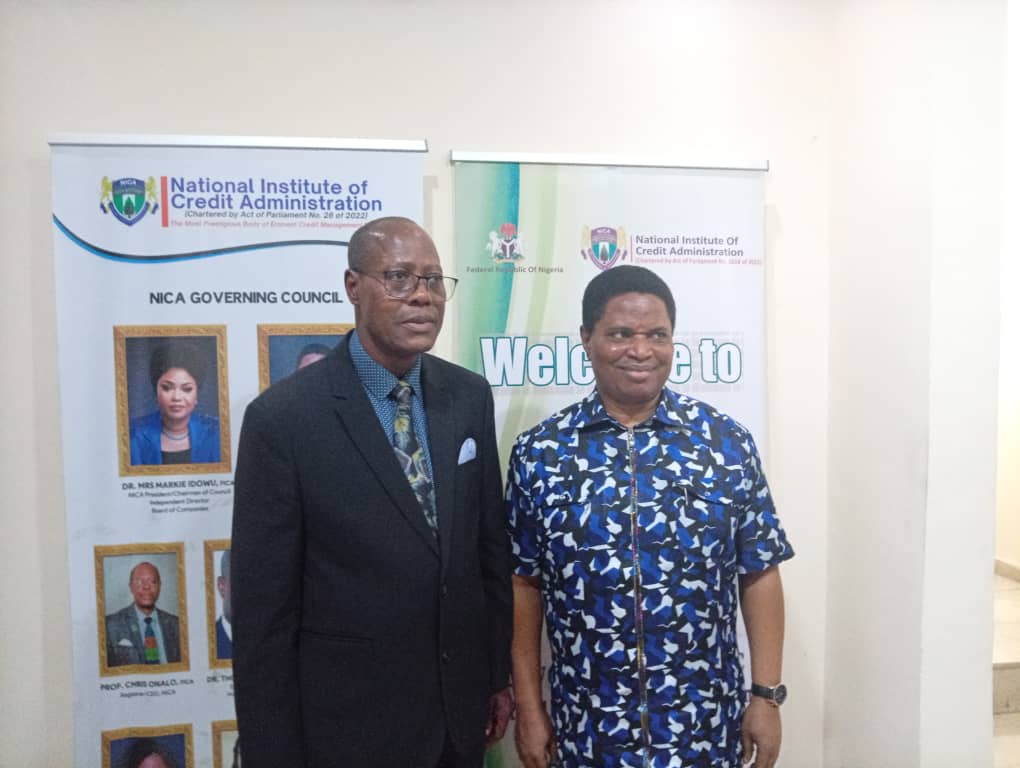
FROMLEFT: Prof. Chris Onalo, Founding Registrar/CEO, NICA and Dr. Felix Amieyeofori, MD/CEO, Entek Intergrated Resources Limited.
Comfort Ekeleme, Business Editor
The National Institute of Credit Administration (NICA), Chartered, has blamed poor credit management, prolonged payment cycles and mounting receivables in Nigeria’s oil, gas and broader energy industry for threatening investment, project execution and sustainable growth in the sector.
The Institute warned that Nigeria’s energy development ambitions would remain constrained unless the country addressed the financial and commercial challenges preventing the effective flow of credit and capital across the energy value chain.
NICA’s Founding Registrar/ Chief Executive Officer, Prof. Chris Onalo, stated this Monday during a press Conference with Energy Journalists in Lagos to unveil the objectives and significance of the forthcoming 2026 National Credit Managers Conference.
According to him, Nigeria’s energy industry does not face only an infrastructure and production challenge but also a serious credit and receivables management problem that requires urgent attention.
He explained that contractors frequently finance operations and wait for months to receive payments, while service providers and vendors operate under extended payment arrangements that sometimes stretch to 180 days.
Similarly, petroleum product marketers depend heavily on credit facilities to finance product purchases and distribution, while gas off-takers rely on long-term commercial agreements that require all parties to fulfil their financial obligations.
Onalo noted that when these credit relationships become unreliable, the consequences spread across the entire industry, resulting in delayed projects, constrained working capital, declining investor confidence and substantial receivables trapped in corporate balance sheets.
He argued that the inability to convert receivables into cash was weakening the capacity of businesses to sustain operations, meet contractual obligations and undertake new investments.
The NICA chief executive stressed that the country’s vast oil and gas reserves would not automatically translate into economic prosperity without adequate financing, investment, infrastructure and reliable commercial relationships.
“What is the value of oil in the ground if the credit required to develop, process, transport and commercialise it cannot flow?” he queried.
He maintained that Nigeria’s energy future would not be unlocked by megawatts alone but through the effective mobilisation of cash, credit and confidence.
Onalo said these concerns informed the decision to dedicate a major session of the 2026 National Credit Managers Conference to the theme, “The Energy, Oil & Gas Credit Revolution: Unlocking the Cash, Credit and Confidence to Power Nigeria’s Energy Future”.
The conference, which is expected to bring together government officials, regulators, financial institutions, energy operators, investors and credit management professionals, will also examine the broader theme, “The Five Pillars of a Creditworthy Nation”.
Speakingfurther, he maintainedthat the conference will provide a platform for developing practical solutions to the financing and credit challenges confronting the country’s productive sectors, particularly the energy industry.
He identified credit guarantees, reliable credit reporting systems, collateral reforms and professional credit management as critical instruments for reducing investment risks and improving access to financing for energy projects.
The conference will also examine how Nigeria can unlock trapped receivables, improve payment cycles and restore liquidity across the oil, gas and wider energy value chain.
Onalo said the expected outcome of the energy-focused session was a practical roadmap for establishing an energy credit ecosystem in which lenders, investors, operators, contractors and consumers could transact with greater confidence.
He added that the desired outcome was an industry where contractors receive payments within agreed timelines, petroleum marketers access financing more easily, gas supply agreements are honoured and vendors are not suffocated by prolonged payment cycles.
“Receivables must become cash, cash must become investment, investment must become projects, and projects must deliver reliable energy and economic prosperity,” he said.
Beyond the energy sector, Onalo explained that the conference would develop a homegrown credit economy framework anchored on five pillars: CreditReady Citizens, CreditWorthy Citizens, CreditManaged Citizens, CreditRules-Abiding Citizens and CreditSustainable Citizens.
He said the framework was designed to promote a national credit culture in which individuals and businesses could access responsible credit based on their credibility, financial history, capacity and repayment behaviour rather than relying exclusively on cash transactions or conventional collateral.
The NICA boss also highlighted the Institute’s statutory mandate under the National Institute of Credit Administration Act No. 26 of 2022, which empowers it to regulate, promote and develop the credit management profession in Nigeria.
He disclosed that the Federal Government’s recognition of credit management as a national profession in October 2024 had reinforced the need for professionally trained and competent credit managers across public and private institutions.
On the Federal Government’s financial inclusion and capacity-building agenda, Onalo said NICA had been called upon to contribute to the national assignment of training 10 million Nigerians, with priority attention to women, youths, graduates and Micro, Small and Medium Enterprises (MSMEs).
He disclosed that the Institute had signed a Memorandum of Understanding with five other professional bodies to establish a collaborative framework for delivering the training programme across the country.
He further announced that NICA had launched an online learning platform offering 13 specialist credit management courses to expand access to professional education and develop the manpower required to support Nigeria’s emerging credit economy.
The Institute has also established a professional relationship with the Africa Credit Rating Agency (AFCRA), launched in Mauritius on October 7, 2026, as part of efforts to strengthen credit management standards and support the development of Africa’s credit ecosystem.
Onalo called on stakeholders in the oil, gas, power and renewable energy industries to actively participate in the conference, stressing that credit development and energy development could no longer be treated as separate national priorities.
He also urged energy correspondents to broaden their reporting beyond infrastructure, production capacity and government expenditure to examine the financial structures, credit arrangements and payment obligations underpinning energy projects.
The National Credit Managers Conference 2026 is scheduled to hold at the Civic Centre, Victoria Island, Lagos, with proceedings commencing at 9:30 a.m.
The conference is expected to provide a platform for defining a Nigerian credit economy model and identifying practical measures to strengthen investment confidence, enterprise development, financial inclusion and sustainable energy growth.
For a better society
_______________________________
Follow us across our platforms:
Instagram – https://www.instagram.com/championnewsonline/
Facebook – https://web.facebook.com/championnewsonline
LinkedIn – https://www.linkedin.com/company/champion-newspapers-limited/
https://x.com/championnewsng/
You can also like and comment on our YouTube videos.
https://youtu.be/QIBfD1tT80w?si=R4Qf3so2LxYu3GC2