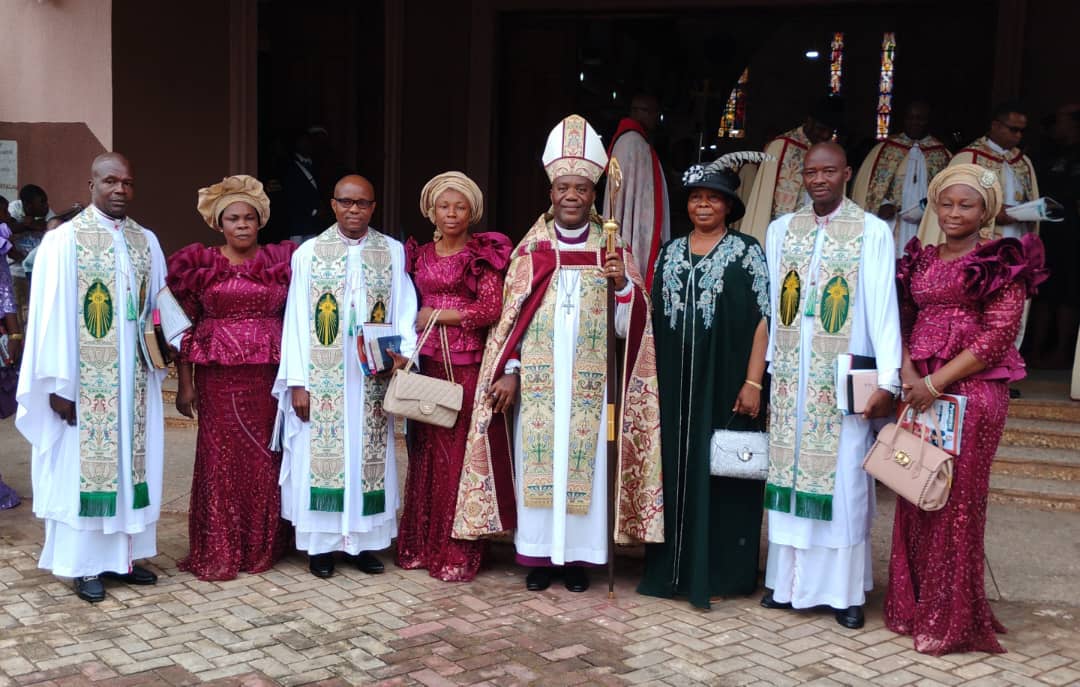
Collated and installed Canons and Bishop Ikeakor Ephraim with their wives.
Kasie Abone, Awka
Bishop of Amichi Diocese, Church of Nigeria (Anglican Communion), Rt. Rev. Ephraim Ikeakor, has charged newly collated canons and installed archdeacons in the diocese to regard their new offices not as trophies or promotions, but as higher calls to service, greater responsibilities and increased accountability before God.
Ikeakor gave the charge while preaching during the collation of canons and installation of three Canons and four Archdeacons at the Cathedral Church of St. Andrew, Amichi.
Those collated and installed as Canons were Rev. Richard Chukwujekwu Ibeto of St . James Anglican Church, Azigbo; Rev. Promise Mbanefo Alor of Church of Pentecost, Ebenator and Rev. Chinedu Odilinna Chukwujekwu of St. Philips Church, Amichi.
Rev. Canon Nnamdi Chinaza Unozor of Masters Vessel Seminary, Osumenyi, Rev. Canon Marcel Chukwuduruo Ezegwu of Diocesan School of Theology, Mission and Evangelism cum St. Jude’s Church, Akala Ezinifite and Rev. Canon Kenechukwu Ikechukwu Anyakoha of St. Stephens Church, Osumenyi.
Preaching on the theme “Beyond Congratulations,” Bishop Ikeakor said the elevation of the clergies should not be reduced to ceremonial recognition or an occasion for receiving congratulatory messages, stressing that ecclesiastical offices come with greater demands and a higher level of accountability.
According to him, “It is not a promotion; it is not a trophy you have won; it is not a medal. It is a new exposure to higher ministry and to the judgment of God after the ministry.”
He therefore urged the newly elevated clergy to take their responsibilities seriously, warning that their new positions would expose them to greater expectations from both the Church and God.
Bishop Ikeakor identified seven major demands which, he said, God was placing on those assuming the new responsibilities, beginning with the need for ability, competence and capacity for ministry.
Drawing from Exodus 18:21 and 2 Timothy 2:15, he said Church leaders must be people with proven ability who continually study to show themselves approved unto God.
He explained that such ability must extend to sound knowledge of Christian doctrine, proper handling of liturgy, administrative competence and effective teaching of the Christian faith.
The bishop challenged the clergy to be sufficiently grounded in the doctrines and traditions of the Church to defend the faith, particularly at a time when the Church was facing increasing challenges.
He specifically questioned whether many clergy could adequately explain and defend the 39 Articles of Religion, which form part of the doctrinal foundation of the Anglican Church.
Ikeakor said those occupying senior ecclesiastical offices should not only be administrators, but must also be competent liturgists, teachers and custodians of Christian doctrine.
He cautioned against what he described as casualness and indiscipline in worship, stressing that liturgy must be conducted with order, reverence and adherence to established Church procedures.
According to him, those who conduct worship or occupy positions of leadership at the altar do not represent themselves alone but stand as representatives of the entire congregation and the Church.
He further identified the fear of God as a critical requirement for effective Church leadership, lamenting that a lack of reverence for God was becoming evident in some aspects of Christian ministry.
The bishop also challenged the clergy to embrace truthfulness and confront dishonesty within the Church.
Referring to the leadership principles contained in Exodus 18, he said those entrusted with responsibility must be people of truth and integrity.
He observed that dishonesty was not limited to spoken falsehoods, explaining that people could also “lie” through their behaviour by presenting themselves as what they were not.
Ikeakor consequently warned against hypocrisy, false appearances, gossip and backbiting, urging the clergymen to ensure that both their words and conduct reflected the truth of their Christian profession.
The bishop also placed strong emphasis on humility, saying genuine humility must be voluntarily embraced as an act of service to God and humanity rather than imposed on a person by circumstances or other people.
He cited Jesus Christ as the supreme example of voluntary humility, urging the new canons and archdeacons to avoid seeking power, recognition and attention at the expense of service.
According to him, humility should be demonstrated in practical acts of service, including willingness to undertake seemingly small tasks without seeking public recognition.
He said leaders who genuinely humble themselves would build healthier relationships and create an environment where their ministry could produce positive spiritual results.
For a better society
_______________________________
Follow us across our platforms:
Instagram – https://www.instagram.com/championnewsonline/
Facebook – https://web.facebook.com/championnewsonline
LinkedIn – https://www.linkedin.com/company/champion-newspapers-limited/
https://x.com/championnewsng/
You can also like and comment on our YouTube videos.
https://youtu.be/QIBfD1tT80w?si=R4Qf3so2LxYu3GC2